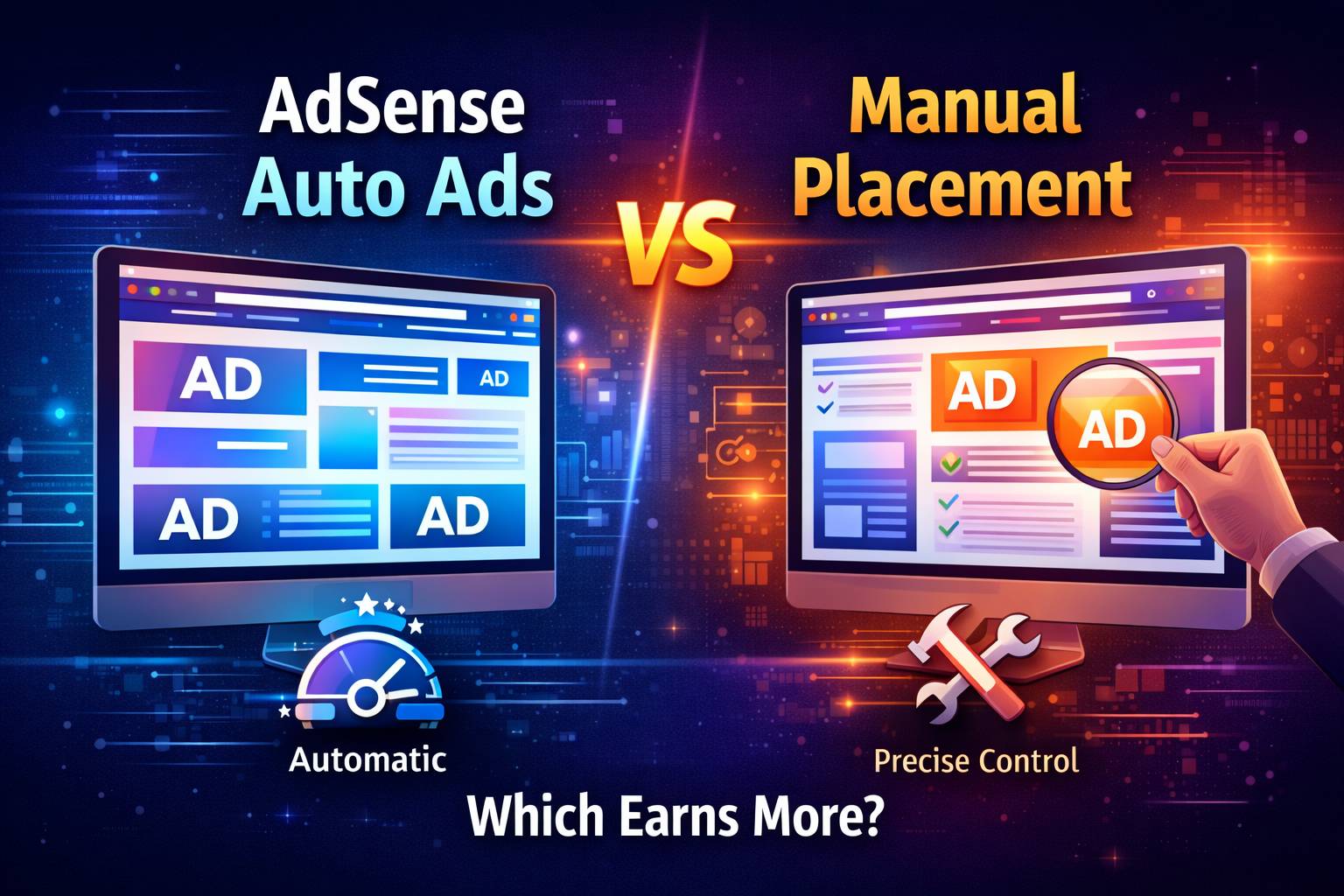
AdSense Auto Ads vs Manual Placement is a common question among website owners trying to maximize their advertising revenue. The way ads are placed on your website directly affects click-through rate (CTR), cost per click (CPC), and overall RPM.
Some publishers prefer Auto Ads because they are easy to set up and automatically optimized by Google’s algorithms. Others prefer manual placement because it gives full control over where ads appear on the page.
Understanding how both systems work can help you choose the right strategy for your website and increase your AdSense income.
This guide explains the differences, advantages, and best use cases for both approaches so you can decide which method earns more for your site.
If you’re new to AdSense, start with this guide:
What Are AdSense Auto Ads?
AdSense Auto Ads automatically place advertisements across your website using Google’s machine learning.
After adding a single code snippet, Google analyzes your:
- page content
- layout structure
- visitor behavior
- device type
Based on this information, the system decides where and how many ads to display.
Key Benefits of Auto Ads
| Feature | Description |
|---|---|
| Easy setup | Only one code snippet required |
| Automatic optimization | Google adjusts placements automatically |
| Responsive ads | Works across desktop and mobile |
| Continuous testing | Google experiments with formats to increase revenue |
Auto Ads are especially useful for large websites with hundreds of pages where manual ad management would take too much time.
To maintain performance, combine Auto Ads with optimized themes like:
What Is Manual Ad Placement?
Manual placement allows publishers to decide exactly where each ad unit appears on a page.
Instead of relying on automation, you manually insert ad codes in specific locations such as:
- above the fold
- inside article content
- sidebar widgets
- header or footer areas
This method gives you complete control over layout, ad size, and user experience.
Advantages of Manual Placement
- greater control over ad layout
- ability to test high-performing positions
- better optimization for high-traffic pages
- improved targeting for high CPC content
Manual placement works particularly well for content optimized for high-value keywords.
Learn how to optimize such pages here:
Auto Ads vs Manual Placement: Performance Comparison
Both approaches can generate good revenue, but results vary depending on site structure and traffic.
| Method | Typical RPM | Best For |
|---|---|---|
| Auto Ads | $5 – $12 | Large blogs with many pages |
| Manual Placement | $6 – $15 | Niche websites with targeted traffic |
Manual placement often produces higher revenue per page, especially when ads are placed near high engagement areas.
However, Auto Ads can still perform well because Google’s algorithm continuously tests ad formats and placements.
When to Use Auto Ads
Auto Ads work best when:
- your website has many pages
- you want minimal ad management
- you publish content frequently
- you prefer automated optimization
Many publishers start with Auto Ads because they require very little technical setup.
When Manual Placement Works Better
Manual ads often perform better when:
- you know where visitors focus on a page
- your content targets high CPC keywords
- you want fewer but higher-value ads
- you run experiments to improve CTR
Strategic ad placement combined with strong SEO can significantly increase earnings.
For example, good internal linking helps keep readers on the page longer:
Hybrid Strategy: The Best of Both Worlds
Many successful publishers combine both approaches.
Example Hybrid Strategy
| Page Type | Recommended Ad Strategy |
|---|---|
| Low traffic posts | Auto Ads |
| High traffic posts | Manual ads |
| Homepage | Manual ads |
| Category pages | Auto Ads |
This approach allows you to:
- automate most pages
- optimize top-performing content manually
Additional Factors That Affect Ad Revenue
Ad placement alone does not determine revenue. Other important factors include:
Content Quality
Well-written content keeps visitors on your page longer, increasing ad impressions.
Page Speed
Fast websites improve user experience and ad viewability.
You can improve performance using:
Traffic Source
Traffic from high CPC countries often generates higher earnings.
Keyword Value
Content targeting business or finance topics often attracts higher paying ads.
Frequently Asked Questions
Do Auto Ads reduce user experience?
Sometimes Auto Ads may insert ads in unexpected places. Adjust settings to limit certain ad types if the layout becomes cluttered.
Is manual placement better for revenue?
Manual placement often produces higher RPM for optimized pages, but it requires regular testing and adjustments.
Can you use Auto Ads and manual ads together?
Yes. Many websites combine both approaches to balance automation and optimization.
Final Thoughts
Both AdSense Auto Ads and Manual Placement have advantages.
Auto Ads offer convenience and automatic optimization, making them ideal for large sites or publishers who want a simple setup.
Manual placement provides greater control and often delivers higher earnings on important pages.
For most publishers, the most effective strategy is a hybrid approach—using Auto Ads for general pages and manual placement for high-traffic content.
With consistent testing, strong SEO, and quality content, you can gradually improve your AdSense revenue and build a reliable monetization strategy.