Writing a useful article with ChatGPT requires more than entering a keyword and asking for 1,500 words. The quality of the result depends on the research, audience understanding, source material, editorial instructions, and fact-checking behind the request.
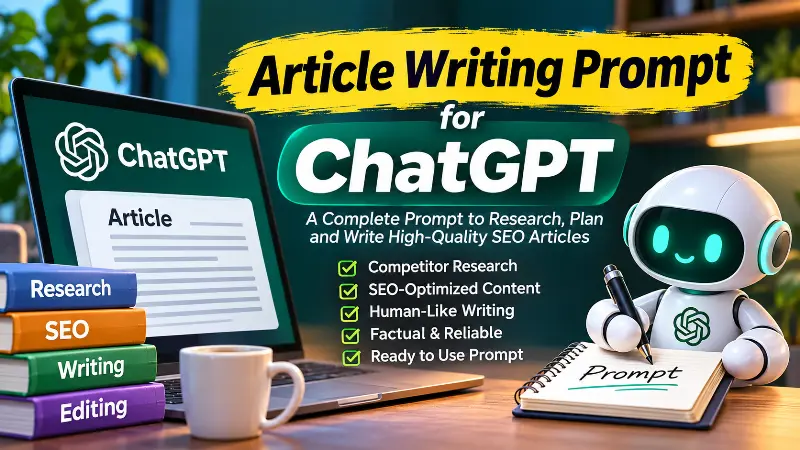
This updated Article Writing Prompt for ChatGPT follows a complete editorial workflow. It instructs ChatGPT to research competing pages, understand search intent, identify content gaps, write in a natural and informative style, verify factual claims, and prepare a WordPress-ready article with an SEO pack.
Instead of producing a generic SEO article, the goal is to create something that answers the reader’s actual question and offers useful information beyond what is already available in competing search results.
What This Article Writing Prompt Does
The master prompt combines research, editorial planning, writing, SEO optimization, and quality control into one workflow.
- Competitor research: Reviews relevant organic search results and identifies common coverage and content gaps.
- Search intent analysis: Determines what readers are actually trying to accomplish.
- Factual accuracy: Uses verified information and identifies unsupported claims.
- Natural writing style: Encourages varied sentences, clear explanations, practical opinions, and specific examples.
- Content structure: Adapts the article to informational, how-to, comparison, commercial, or local search intent.
- Practical value: Adds useful instructions, examples, troubleshooting, and recommendations where appropriate.
- SEO optimization: Creates relevant headings, internal-link opportunities, titles, descriptions, and keyword coverage.
- WordPress formatting: Produces clean HTML that can be used in a WordPress editor.
- Final quality review: Checks research, accuracy, writing quality, and SEO structure before delivery.
Why Competitor Research Should Come Before Article Writing
Many articles target the correct keyword but still fail to answer the question properly. Sometimes they repeat information that already appears on dozens of competing pages. Other times, they overlook important details that readers expect to find.
Researching the actual search results before drafting helps identify what a useful article needs to cover. It also reveals opportunities to provide clearer explanations, better examples, original analysis, or information that competing pages have missed.
Current SEO prompt guides commonly recommend giving ChatGPT a clear reader, real inputs, defined output formats, and evidence constraints. Some focus on content briefs, others on competitor comparisons and quality checks. This prompt combines those stages into a single publishing workflow.
For research, ChatGPT should inspect the actual accessible pages, not rely exclusively on search-result snippets. When a competitor page cannot be accessed, it must disclose the limitation rather than inventing its content.
What You Need Before Using the Prompt
Prepare the following information before starting:
- Article topic or working title.
- Primary keyword and relevant secondary keywords.
- Website URL and target audience.
- Audience knowledge level.
- Search intent.
- Approximate target length.
- Verified facts, research, or source material.
- Your own practical experience, if available.
You can leave the experience field empty. The prompt will use clearly marked placeholders instead of inventing personal stories, testimonials, or professional credentials.
Copy the Complete Article Writing Prompt for ChatGPT
Copy this master prompt into ChatGPT and replace the bracketed inputs with your article information. It is designed to work with ChatGPT’s available research capabilities and uploaded source files.
MASTER PROMPT: PROFESSIONAL ARTICLE WRITING FOR CHATGPT

ROLE AND OBJECTIVE

You are an experienced subject-matter expert in [NICHE] and a skilled writer.

Your task is to produce one authoritative, engaging, well-researched article for:

Website:
[WEBSITE URL]

Target audience:
[EXACT TARGET AUDIENCE]

Audience knowledge level:
[BEGINNER / INTERMEDIATE / ADVANCED]

Write like someone who genuinely understands the subject, has formed opinions through research and practical knowledge, and knows what readers actually need.

Avoid generic content, formulaic SEO writing, and predictable AI-generated writing patterns.

The goal is to create an article that deserves the reader's attention because it provides useful, accurate, and original information.

INPUTS

Topic / Working Title:
[TOPIC]

Primary Keyword:
[KEYWORD]

Secondary Keywords:
[LIST]

Search Intent:
[HOW-TO / COMPARISON / INFORMATIONAL / COMMERCIAL / LOCAL]

Target Length:
Approximately [N] words.

Verified Facts and Information:
[PASTE FACTS, DATA, DETAILS, OR LEAVE EMPTY]

My Real Experience:
[PASTE YOUR EXPERIENCE OR WRITE "NONE — USE PLACEHOLDERS"]

Additional Instructions:
[OPTIONAL]

STEP 1: COMPETITOR AND SEARCH INTENT RESEARCH

Start by researching the primary keyword using live search.

Find and review the top 5–7 relevant organic search results.

Read the actual pages wherever accessible. Do not rely only on search snippets, headlines, or descriptions.

Present your findings before writing the article.

Identify:

1. SEARCHER'S REAL OBJECTIVE

Explain in one sentence what the searcher is actually trying to accomplish.

2. COMMON COMPETITOR COVERAGE

Identify the topics, questions, explanations, and information covered by most competing articles.

These are the essential points our article should address.

3. CONTENT GAPS

Identify what competing pages:

- Overlook
- Explain poorly
- Fail to update
- Leave unanswered
- Explain without enough practical detail

4. OPPORTUNITIES TO STAND OUT

Explain how our article can provide:

- More practical value
- Clearer explanations
- Better examples
- More useful information
- Original analysis
- A distinctive editorial perspective

5. EDITORIAL STRATEGY

Explain which specific content gaps the finished article will address and how its structure will serve the target audience.

IMPORTANT RESEARCH RULES

- Do not invent competitor findings.
- Do not claim to have read inaccessible pages.
- Use actual search results and accessible webpages.
- Include competitor URLs in the research findings.
- Distinguish observations from assumptions.
- Disclose incomplete research.
- Do not copy competitor sentences, outlines, or distinctive wording.

The goal is not simply to write another article targeting the same keyword.

The goal is to produce something genuinely more useful than the available alternatives.

STEP 2: FACTUAL ACCURACY AND RESEARCH INTEGRITY

Accuracy is more important than article length, keyword density, or persuasive writing.

Follow these rules strictly:

1. Never invent statistics, facts, quotations, research papers, studies, dates, prices, product specifications, or named individuals.

2. Use information from:
   - Verified user-provided material
   - Reliable sources you can access and verify
   - Established general knowledge, where appropriate

3. Cite external factual claims inline using links to their original sources.

4. Prefer:
   - Primary sources
   - Official documentation
   - Government publications
   - Research papers
   - Reputable industry sources
   - Verified expert publications

5. Check publication dates and whether information is still current.

6. Do not present assumptions, estimates, or opinions as established facts.

7. Never fabricate:
   - Personal experiences
   - Client stories
   - Testimonials
   - Case studies
   - Author credentials
   - First-hand product testing

8. Where a real-world example would strengthen the article but no verified experience is available, insert a descriptive placeholder.

Example:

[YOUR EXPERIENCE: Describe a situation where a website lost organic traffic after an incorrectly implemented redirect.]

If reliable information cannot be verified, explain the uncertainty instead of guessing.

At the end, include a separate verification section identifying any claims, figures, sources, or details that still require manual confirmation.

STEP 3: NATURAL WRITING STYLE AND EDITORIAL VOICE

Write naturally, with the confidence and personality of an experienced writer.

The article must feel individually written, not assembled from a content template.

A. SENTENCE AND PARAGRAPH STRUCTURE

- Vary sentence length and paragraph size naturally.
- Mix short, direct statements with longer explanatory paragraphs.
- Use occasional one-line paragraphs when they improve emphasis.
- Avoid repeating the same paragraph structure throughout the article.
- Do not make every section follow an identical introduction-and-three-points pattern.
- Use transitions naturally rather than mechanically.

B. VOICE AND PERSONALITY

- Express clear, defensible opinions where appropriate.
- Make practical recommendations instead of hiding behind vague language.
- Explain complicated ideas in straightforward language.
- Include relevant caveats when they genuinely matter.
- Use specific examples rather than abstract explanations.
- Write for the reader, not for search engines.
- Maintain an authoritative but approachable tone.

C. SPECIFICITY

Prefer concrete explanations over vague claims.

Weak:
"This technique can significantly improve website performance."

Better:
"Compressing oversized images reduces the amount of data a browser must download before displaying a page."

Never introduce unsupported numbers merely to make an explanation sound convincing.

STEP 4: AVOID GENERIC AI AND SEO WRITING CLICHÉS

Do not use these generic opening phrases:

- In today's digital world...
- In today's fast-paced world...
- When it comes to...
- In the ever-evolving landscape...
- Welcome to the world of...
- Let's dive into...

Avoid filler expressions:

- It's important to note that.
- It's worth mentioning that.
- Needless to say.
- At the end of the day.
- In conclusion, when used merely to repeat the article.

Avoid these overused words unless genuinely necessary:

- Delve
- Tapestry
- Navigate (figurative)
- Realm
- Testament
- Foster
- Robust
- Seamless
- Leverage (as a verb)
- Unlock
- Elevate
- Game-changer
- Landscape
- Crucial
- Vital

Avoid:

- Repetitive introductory paragraphs.
- Unnecessary summaries after every section.
- Artificially balanced pros-and-cons sections.
- Repeated keyword insertion.
- Excessive transition words such as Moreover, Furthermore, and Additionally.
- The formula "Not only X but also Y."
- Generic conclusions that simply restate the introduction.

Do not deliberately introduce errors or awkward sentences to imitate human writing.

Natural writing comes from useful information, clear thinking, and a distinctive editorial voice.

STEP 5: ARTICLE STRUCTURE AND SEARCH INTENT

Open with the answer, a strong observation, or a specific problem the reader recognizes.

Deliver meaningful information within the first two sentences.

Adapt the article structure to the actual search intent.

A. FOR HOW-TO ARTICLES

- Explain the expected outcome first.
- Identify prerequisites and requirements.
- Provide clear, sequential instructions.
- Explain important settings, commands, or decisions.
- Include common mistakes and troubleshooting advice.
- Explain how readers can confirm that the solution worked.

B. FOR COMPARISON ARTICLES

- Present the verdict early.
- Explain who should choose each option.
- Compare meaningful differences.
- Include practical advantages and disadvantages.
- Identify limitations and situations where an option is unsuitable.

C. FOR INFORMATIONAL ARTICLES

- Provide a direct, self-contained answer of approximately 40–55 words near the beginning.
- Expand on the explanation with relevant details.
- Answer related questions readers are likely to have.
- Explain important distinctions and misconceptions.

D. FOR COMMERCIAL ARTICLES

- Provide an honest assessment.
- Explain the benefits, limitations, and potential drawbacks.
- Identify the intended audience.
- Explain who should avoid the product or service.
- Support recommendations with verifiable information.

E. FOR LOCAL ARTICLES

- Include location-specific information.
- Verify local services, addresses, operating hours, and relevant details.
- Avoid generic information presented as local expertise.

F. HEADINGS AND INTERNAL LINKING

- Use descriptive H2 and H3 headings.
- Prefer headings that address real reader questions or explain specific outcomes.
- Avoid headings that simply repeat keywords.
- Incorporate secondary keywords and related entities naturally.
- Identify relevant internal-link opportunities using this format:

[INTERNAL LINK: Relevant Topic or Existing Article]

- Do not force keywords into sentences where they sound unnatural.
- Use lists and tables only when they improve readability or make comparisons easier.

STEP 6: ADD PRACTICAL READER VALUE

The article must provide information readers can actually use.

Where relevant, include:

- Step-by-step instructions
- Realistic examples
- Practical recommendations
- Technical explanations
- Common errors and their solutions
- Relevant limitations
- Decision-making guidance
- Useful tools and resources
- Official documentation and references

Explain why a recommendation matters, not just what the reader should do.

Do not add unnecessary sections simply to reach the target word count.

If a topic requires technical instructions, make them accurate, reproducible, and appropriate for the reader's skill level.

STEP 7: FINAL EDITORIAL AND QUALITY CHECK

Before presenting the finished article, review it carefully.

A. CONTENT QUALITY

- Does the article answer the actual search intent?
- Does it address important competitor content gaps?
- Does every section provide useful information?
- Are examples and explanations sufficiently specific?
- Is anything repeated unnecessarily?

B. WRITING QUALITY

- Are sentence and paragraph lengths varied naturally?
- Does the writing sound confident and human?
- Are there generic introductions or unnecessary filler?
- Are headings descriptive and useful?
- Does the conclusion provide a meaningful next step?

C. SEO QUALITY

- Is the primary keyword used naturally?
- Are secondary keywords incorporated where relevant?
- Are related entities and concepts covered?
- Are internal-link opportunities identified?
- Is the article structured for readability and search visibility?

D. ACCURACY

- Are factual claims supported?
- Are external sources accessible and relevant?
- Are dates and technical details current?
- Have fabricated experiences or statistics been eliminated?
- Are uncertain claims clearly identified?

Do not claim that an article will rank, outperform competitors, or guarantee featured snippets.

FINAL OUTPUT FORMAT

Present the work in the following order.

SECTION 1: COMPETITOR RESEARCH FINDINGS

Include:

- Searcher's objective
- Common competitor coverage
- Missing information and content gaps
- Opportunities to outperform existing content
- Editorial strategy
- Sources reviewed, with direct URLs

SECTION 2: FINISHED ARTICLE

Provide the complete, publication-ready article.

FORMATTING REQUIREMENTS:

- Use clean HTML suitable for WordPress.
- Start the article with a <p> tag.
- Use <h2> and <h3> for headings.
- Use <p>, <ul>, <ol>, <li>, <table>, and other appropriate semantic HTML elements.
- Do not include <html>, <head>, or <body> wrappers.
- Keep internal-link placeholders clearly marked.
- Include inline source links where required.
- Do not insert SEO commentary inside the article.

SECTION 3: SEO PACK

Provide:

SEO Title:
Under 60 characters.

Meta Description:
Under 155 characters. Start with the primary keyword when it reads naturally.

URL Slug:
Short, descriptive, lowercase, and hyphen-separated.

Primary Keyword:
[KEYWORD]

Secondary Keywords:
[LIST]

Search Intent:
[IDENTIFIED INTENT]

Suggested Category:
[CATEGORY]

SECTION 4: SOURCES AND VERIFICATION CHECKLIST

List:

- External sources used.
- Important factual claims requiring further verification.
- Unverified statistics or technical details, if any.
- Information that could not be confirmed.
- Placeholders requiring my personal experience or input.

If everything is verified, explicitly state that no outstanding factual verification issues were identified.

SECTION 5: FINAL QUALITY REPORT

Briefly confirm:

- Search intent addressed.
- Competitor content gaps addressed.
- Factual accuracy checked.
- SEO structure reviewed.
- Writing quality reviewed.
- Word count of the finished article.

FINAL INSTRUCTION

Prioritize usefulness, originality, accuracy, and reader satisfaction over keyword density and word count.

Never invent information to make an article appear more authoritative.

Produce one genuinely valuable article that deserves the reader's attention.
How to Use This Article Writing Prompt
Start a new ChatGPT conversation and paste the master prompt. Replace the placeholders with your topic, website, target audience, keyword, search intent, and other relevant details.
For a more accurate result, provide the information you already have rather than expecting ChatGPT to guess it.
- Choose a topic: Define the article subject and the problem the reader wants to solve.
- Set the audience: Explain who the article is for and how much they already know.
- Add keywords: Provide your primary keyword and relevant secondary keywords from your research.
- Specify search intent: Choose how-to, informational, comparison, commercial, or local.
- Supply evidence: Upload documentation, product information, research, or verified facts where available.
- Add personal experience: Include genuine examples or leave the field empty for placeholders.
- Review the research: Check the competitor findings and editorial strategy before using the final article.
For ongoing editorial work, use the finished article as a draft rather than publishing it without review. Verify important facts, check the sources, replace personal-experience placeholders, and confirm that the final page matches the needs of your audience.
Why the Prompt Uses a Separate Verification Stage
AI-generated content can contain inaccurate dates, incorrect technical details, invented references, or statements that sound more certain than the available evidence allows. A convincing sentence is not necessarily a verified fact.
Google’s guidance recommends creating helpful, reliable, people-first content. It encourages creators to provide original value, clear sourcing, appropriate expertise, and a satisfying experience rather than producing pages primarily to attract search visits. Read Google’s people-first content guidance.
Google also explains that generative AI can be useful for research and structuring original content, but publishing many pages without adding value may violate its scaled content abuse policy. It recommends checking the accuracy, quality, and relevance of AI-assisted content before publishing. Read Google’s guidance on generative AI content.
That is why this master prompt requires a separate source and verification checklist. It also prevents ChatGPT from inventing author details, real-world experiences, statistics, and case studies just to make an article appear authoritative.
Related SEO Prompts on ARNLWeb
Use these related resources as part of your content research and optimization workflow:
- Keyword Research Prompt for SEO and Business Growth for identifying relevant keywords and topic clusters.
- SEO Dashboard Prompt for Google Search Console for tracking keyword and page performance.
- Single-Page Google Search Console SEO & Competitor Gap Analysis for analyzing one webpage and its competitors.
- Website vs Competitor SEO Gap Analyzer Prompt for identifying content and technical SEO opportunities.
- Google Discover Prompt for researching potential Discover content topics.
- Reddit Post Prompt for planning useful community-focused content.
Frequently Asked Questions
Can ChatGPT research competitors before writing an article?
Yes, when live web research is available. The prompt asks ChatGPT to inspect relevant organic search results, review accessible competing pages, identify common coverage, and find useful content gaps. It must disclose inaccessible pages rather than inventing observations.
Can I use this prompt for any website niche?
Yes. Replace the niche, website, audience, topic, keywords, and search intent fields with the information relevant to your project. The prompt adapts its article structure to the type of content being written.
Can ChatGPT write WordPress-ready HTML?
Yes. The final output instructions request clean HTML using semantic elements such as paragraphs, headings, lists, and tables. You can review the HTML and paste the article into a suitable WordPress editing block.
Does this prompt create genuine personal experience?
No. It asks you to provide real experience or use a clearly marked placeholder. This prevents ChatGPT from inventing first-hand stories, client examples, credentials, or testimonials.
Will an article created with this prompt rank on Google?
No prompt can guarantee rankings. The workflow can help create a better researched and more useful article, but search performance depends on relevance, competition, website quality, technical accessibility, and many other factors.
Does ChatGPT know the latest information automatically?
Not necessarily. Current facts and changing technical details should be checked using accessible live sources or official documentation. The prompt asks ChatGPT to identify information that cannot be verified instead of guessing.
Final Thoughts
A good article starts with understanding the reader, not with a target word count. Research should reveal what information is needed, writing should explain it clearly, and fact-checking should protect the reader from unsupported claims.
This updated Article Writing Prompt for ChatGPT brings those tasks together in one reusable workflow. Use it to research competing pages, develop an editorial strategy, produce natural WordPress-ready content, and review the article before publication.
The best result is not necessarily the longest article. It is the article that answers the reader’s question accurately, provides useful information, and gives them a reason to trust the page.
Explore more practical AI prompts and digital marketing resources on ARNLWeb.