
A Google Search ranking drop after a spam update can be worrying, especially when several pages lose organic clicks at the same time. However, a traffic decline does not automatically mean Google classified a website or its content as spam.
The right approach is to investigate the evidence before deleting pages, rewriting content, changing URLs, or submitting a reconsideration request. A useful recovery process should identify affected pages, look for shared patterns, inspect the actual content, make justified corrections, and measure performance after the update.
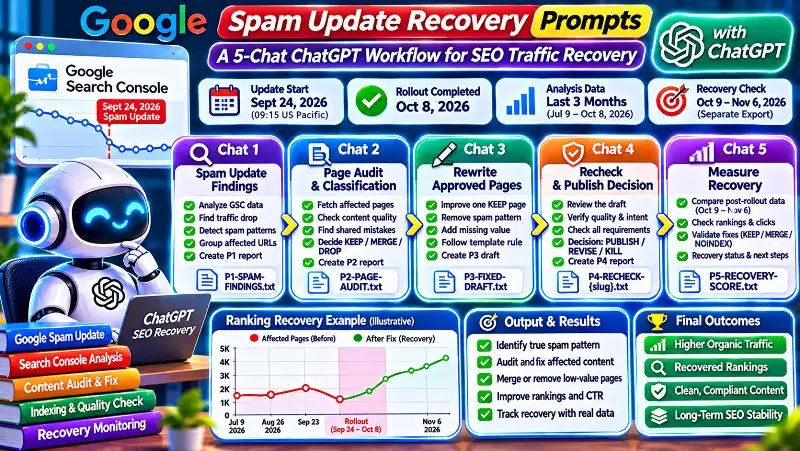
This guide provides five reusable ChatGPT prompts for that process. Each prompt handles a different stage, from Google Search Console analysis to page auditing, content improvement, quality checks, and post-update recovery measurement.
What Is the Five-Chat Spam Update Recovery Workflow?
The workflow divides the investigation into five separate ChatGPT conversations. Each conversation produces a structured text packet that becomes the input for the next conversation.
| Chat | Task | Output |
|---|---|---|
| Chat 1 | Analyze Search Console data and identify possible shared spam patterns. | P1 Spam Findings |
| Chat 2 | Fetch and audit the affected pages. Decide whether each page should be kept, merged, or dropped. | P2 Page Audit |
| Chat 3 | Rewrite one approved page while addressing the identified content problem. | P3 Fixed Draft |
| Chat 4 | Review the replacement draft and decide whether to publish, revise, or kill it. | P4 Recheck |
| Chat 5 | Measure post-update performance against the original affected pages and approved actions. | P5 Recovery Score |
This separation makes the work easier to review. The first chat identifies possible patterns, the second examines actual pages, the third produces a replacement, the fourth checks its quality, and the fifth evaluates the available recovery evidence.
Important: September 2026 Spam Update Dates
The date windows in this workflow are built around Google’s September 2026 spam update. According to Google’s official Search Status Dashboard, the update began on September 24, 2026, at 09:15 US Pacific time and was completed on October 8, 2026, at 01:00 US Pacific time.
The supplied workflow uses these analysis windows:
| Window | Date range | Purpose |
|---|---|---|
| Baseline | First date in the original export to August 26, 2026 | Understand performance before the comparison period. |
| Before update | August 27 to September 23, 2026 | Establish the pre-rollout performance level. |
| Rollout | September 24 to October 8, 2026 | Investigate changes during the update rollout. |
| Settled period | October 9 to November 6, 2026 | Evaluate post-rollout performance. |
For the original P1 analysis, the expected Search Console export is approximately July 9 to October 8, 2026. The exact first and last dates must come from the uploaded file, not an assumption.
Important data limitation: An export ending on October 8 cannot measure recovery during October 9 to November 6. Chat 5 therefore needs a later Search Console export containing the settled period. Without it, the correct result is TOO_EARLY, not RECOVERED. The original P1 export remains the reference for identifying affected URLs.
Before You Start
Prepare the following:
- One Google Search Console Performance export covering the original three-month period, ending October 8, 2026.
- The website’s Manual Actions report or an exported record of its status.
- Access to the affected webpages so ChatGPT can inspect their actual content.
- For the final recovery check, a later Search Console export covering October 9 to November 6, 2026.
Use the Search Console Performance report with the relevant clicks, impressions, CTR, average position, dates, pages, and queries. Google explains that average position is an aggregated metric, not a fixed live ranking for every search. Google’s explanation of clicks, impressions, and position.
Also check the Manual Actions report. A missing manual-action file must be recorded as MISSING, not interpreted as proof that no manual action exists. Google’s report identifies manual actions issued following a human review. Google Search Console Manual Actions report.
Prompt 1: Identify Spam Patterns Using Google Search Console
Purpose: Analyze the original Search Console export, identify affected pages, and determine whether the losses show evidence of a shared pattern.
Start ChatGPT Chat 1. Upload the original Search Console export and any available Manual Actions report. Paste this prompt:
PROMPT 1: SEPTEMBER 2026 SPAM UPDATE FINDINGS

You are Chat 1 of 5. Use ChatGPT to audit the September 2026 spam update using one Google Search Console export covering approximately 9 July 2026 to 8 October 2026.

Do not ask me for a date, website URL, or second initial export. Identify the website and dates from the uploaded file.

Your deliverable is:
P1-spam-findings.pdf
P1-SPAM-FINDINGS.txt

UPDATE INFORMATION

Update: September 2026 spam update
Start: 24 September 2026, 09:15 US Pacific
Completion: 8 October 2026, 01:00 US Pacific
Official rollout status: COMPLETE
Scope: Global, all languages

Use the following fixed analysis windows:

Baseline: First date in the file through 26 August 2026.
Before: 27 August 2026 through 23 September 2026.
Rollout: 24 September 2026 through 8 October 2026.

The actual first and last dates must come from the uploaded file.

DATA INSTRUCTIONS

1. Inspect every uploaded file.
2. Identify the website and reporting date range.
3. Read the Manual Actions report if supplied.
4. If no Manual Actions report or usable manual-action evidence is supplied, record manual_action as MISSING.
5. If the report explicitly confirms no manual action, record NONE.
6. Never assume that missing evidence means no manual action.

If a sheet contains a date column, calculate clicks in the before and rollout windows separately.

If Pages or Queries are totals for the entire three-month period, use the daily chart to test whether the site-level decline begins on or after 24 September.

In that case:
- Rank pages by clicks in the available file.
- Mark page-level timing as NOT_PROVEN.
- Do not invent before-and-after page metrics.

LOSER IDENTIFICATION

A page is a potential loser only when the available evidence supports a meaningful click decline beginning during the rollout, not a decline already visible in the baseline or before period.

Assign every declining URL to one category:

SPAM_PATTERN
QUALITY_OR_CORE
TECHNICAL
OTHER

Use SPAM_PATTERN only when there is evidence of a shared pattern.

Investigate whether:
- Several pages share a folder, template, or title formula.
- Many related queries have been lost.
- Average position has worsened.
- The URLs remain indexed, where index status can be verified.
- Clicks declined while impressions remained relatively stable.

A single-page dip, sitewide fluctuation, country-only change, or branded-demand decline is not enough to label a page a spam hit.

This is an in-rollout diagnosis, not a recovery measurement.

ANALYSIS

Calculate the available click changes using actual source data.

Identify:
- Site-level click changes
- Pages with the largest losses
- Query losses
- Shared page templates
- Repeated titles or content structures
- Position changes
- Impression patterns
- Pages that should not be changed

Separate confirmed findings from hypotheses.

Do not invent URLs, numbers, query losses, indexing status, or causes.

VERDICT

Choose one:

SPAM_PATTERN
MANUAL_ACTION
MIXED
NOT_SPAM

Use MANUAL_ACTION only when an actual manual action is evidenced.
Use MIXED when there is evidence of both a shared spam pattern and a manual action.
Use NOT_SPAM when the supplied evidence does not support a spam-pattern diagnosis.

OUTPUT REPORT

Create a simple-English report explaining:
1. Website and data period
2. Update timeline
3. Manual action status
4. Site-level performance
5. Potential spam-pattern pages
6. Other declining pages
7. Shared traits
8. What cannot be proven
9. URLs requiring page inspection

PACKET_P1

update: September 2026 spam update
source_file: last_3_months
file_start:
file_end:
verdict: SPAM_PATTERN | MANUAL_ACTION | MIXED | NOT_SPAM
before_window: 2026-08-27 to 2026-09-23
rollout_window: 2026-09-24 to 2026-10-08
page_level_timing: DATED | NOT_PROVEN
completion_posted: YES
site:
manual_action:
lost_clicks_total:
spam_share_of_lost_clicks:
templates:
- folder_or_type | url_count | before_clicks | rollout_clicks | share_of_lost_clicks | repeated_pattern
spam_losers:
- url | template | before_clicks | rollout_clicks | click_change_pct | before_position | rollout_position | queries_lost | why_spam_pattern
do_not_touch:
- url | bucket | why
shared_traits:
- trait | evidence_from_export
fetch_queue_for_chat_2:
- url
cannot_prove:
- item
END_PACKET_P1

Save the packet as P1-SPAM-FINDINGS.txt.

If the verdict is NOT_SPAM, stop. Do not recommend mass content deletion or rewriting without evidence.
How to Read the First Report
Do not treat every URL with declining clicks as a spam-related page. The first report should look for repeated patterns and distinguish them from technical problems, normal search fluctuations, and other causes.
Google’s own traffic-drop guidance recommends examining the timing and scope of losses, including whether declines affect the entire website, a group of pages, or an individual page. It also recommends looking at impressions, clicks, position, and the affected page groups. Google’s traffic-drop debugging guide.
If page-level before-and-after data is not available, the report must say NOT_PROVEN. A list of the most-clicked pages in a three-month export is not automatically a list of pages hit by an update.
Prompt 2: Audit the Affected Pages and Identify Shared Content Problems
Purpose: Fetch only the URLs identified in P1 and inspect their actual content. Classify each page as KEEP, MERGE, or DROP, based on the evidence.
Start a new ChatGPT conversation. Upload P1-SPAM-FINDINGS.txt and paste this prompt:
PROMPT 2: AFFECTED PAGE AUDIT

You are Chat 2 of 5 for the September 2026 spam update.

I am uploading P1-SPAM-FINDINGS.txt from Chat 1.

Your deliverables are:
P2-page-audit.pdf
P2-PAGE-AUDIT.txt

SOURCE RULE

PACKET_P1 is the only URL list you may audit.

If PACKET_P1 verdict is NOT_SPAM, stop.

Fetch every URL listed in:
- fetch_queue_for_chat_2
- spam_losers

Do not ask me to manually paste a page unless fetching fails.

The date windows are already fixed:

Before: 27 August 2026 to 23 September 2026.
Rollout: 24 September 2026 to 8 October 2026.

PAGE TIMING RULE

If page_level_timing is NOT_PROVEN:
- State that the URL list is based on three-month ranking totals.
- Do not treat every high-click URL as a dated loser.
- Do not invent page-level before-and-after figures.

PAGE INSPECTION

For each accessible URL, inspect:

- Page title
- Meta description
- H1
- H2 and H3 outline
- Opening paragraphs
- Visible author
- Visible publication or update date
- Main content
- Approximate word count
- Repeated content blocks
- Useful information and reader value

GROUP AND COMPARE

Group fetched pages using the templates and shared_traits in PACKET_P1.

Compare pages with each other.

Investigate only where the page text supports it:

- Scaled content abuse
- Doorway abuse
- Thin or near-duplicate templates
- Scraped or spun content
- Site reputation abuse
- Expired-domain topic mismatch, only if supported by evidence
- Keyword stuffing
- Hidden text
- Empty answer blocks
- Repeated pages that do not provide distinct value

Quote the actual page text as evidence.

Do not claim a policy violation that cannot be demonstrated.

PAGE DECISION

Assign each fetched URL exactly one action:

KEEP:
The reader still needs the URL and it can be made genuinely distinct and useful.

MERGE:
The page substantially overlaps another page. Identify exactly one destination URL.

DROP:
The page exists primarily to capture a query without providing a distinct reader purpose. Recommend noindex or deletion, explaining the evidence.

FETCH_FAILED:
The page could not be inspected. Do not classify it as spam or recommend deletion based on missing content.

For a DROP recommendation, explain whether noindex or deletion is more appropriate.

For a MERGE recommendation, specify the exact destination and a 301 redirect.

Do not make website changes.

REPORT

Explain the shared mistake in simple English.

Compare the pages and identify:
- The repeated content pattern
- The reader value missing
- What should be removed
- What should be retained
- What should be consolidated

PACKET_P2

built_from: PACKET_P1
update: September 2026 spam update
source_file: last_3_months

pages_fetched:
- url | fetch_status | title | h1 | word_count_estimate

shared_mistake:

template_rule:

pages:
- url | action | policy | evidence_quote | merge_target_or_none

keep_queue:
- url | query_it_should_deserve | reader_job | must_remove | must_add

merge_map:
- from_url | to_url | redirect: 301

drop_list:
- url | noindex_or_delete | why

fetch_failed:
- url | error

END_PACKET_P2

Save as P2-PAGE-AUDIT.txt.

Open one new Chat 3 conversation for each KEEP URL.

Do not rewrite DROP URLs. Do not rewrite MERGE URLs as independent pages.
Why the Page Audit Matters
A shared template does not automatically mean every page using it should be deleted. Some pages may serve different reader needs even if they use the same design. The audit must compare the actual content, not just URL patterns or titles.
Google’s spam policies describe scaled content abuse as producing many pages primarily to manipulate rankings rather than help users. The policy applies regardless of whether the content is generated by AI, scraped, or created through another method. Doorway abuse and thin affiliate content are also covered by Google’s policies. Google Search spam policies.
Prompt 3: Rewrite One Approved Page
Purpose: Produce a replacement draft for one KEEP URL. The page must solve a clear reader problem and remove the specific shared mistake identified in P2.
Open a separate ChatGPT conversation for each KEEP URL. Upload P2-PAGE-AUDIT.txt and replace FIRST_KEEP_URL with the selected URL.
PROMPT 3: FIX ONE APPROVED PAGE

You are Chat 3 of 5 for the September 2026 spam update.

I am uploading P2-PAGE-AUDIT.txt.

Your deliverable is:
P3-fixed-draft.pdf
P3-FIXED-DRAFT-[slug].txt

URL TO FIX:
FIRST_KEEP_URL

SOURCE RULE

Read the matching row in keep_queue.

The following fields are binding:
- shared_mistake
- template_rule
- reader_job
- must_remove
- must_add

If the matching KEEP row is missing, stop.

FETCH AND SERP RESEARCH

1. Fetch the live target URL.
2. Check current Google search results for its intended query.
3. Inspect competing pages only to understand reader needs that the target page still does not satisfy.
4. Do not copy competitor sentences, headings, or outlines.
5. Do not ask me to paste the article unless fetching fails.

CONTENT REQUIREMENTS

Write a replacement only after inspecting the actual page and checking the relevant search results.

The replacement must:
- Fulfil the reader_job in the KEEP row.
- Remove the shared_mistake.
- Follow the template_rule.
- Remove every must_remove item.
- Add the useful information described in must_add.
- Answer the intended query naturally.
- Retain useful facts and genuinely valuable information from the original page.
- Avoid repetitive or artificial content expansion.
- Avoid keyword stuffing.
- Avoid copying competitors.

Do not invent:
- Statistics
- Authors
- Reviews
- Prices
- Personal experience
- Research findings
- Sources
- URLs

Use these markers when information needs real verification:

[NEED REAL EXAMPLE]
[NEED AUTHOR]
[NEED SOURCE]
[NEED URL]

Do not remove these markers merely to make the article look complete.

REPORT

Explain in simple English:
- What was removed
- What was added
- How the page now fulfils its reader job
- How the draft differs from the repeated template
- What remains unverified

Provide the complete replacement draft.

PACKET_P3

built_from: PACKET_P2
update: September 2026 spam update
source_file: last_3_months

url:
query:
reader_job:
shared_mistake:

live_page_fetched: YES | NO
serp_checked: YES | NO

removed_in_this_draft:
- item | quote_or_reason

section_map:
- h2 | reader_job_finished | our_gap_or_serp_gap

draft: |
[FULL REPLACEMENT]

cut_list:
- block | why

title_options:
-
-
-

unverified:
- marker

END_PACKET_P3

Save as P3-FIXED-DRAFT-[slug].txt.

For the next KEEP URL, start a new Chat 3 conversation and replace FIRST_KEEP_URL with that URL.
Prompt 4: Recheck the Replacement Before Publishing
Purpose: Check that the replacement draft actually removes the identified problem, answers the intended query, and retains useful information from the live page.
Start a new ChatGPT conversation. Upload one P3-FIXED-DRAFT file and paste this prompt:
PROMPT 4: RECHECK THE REPLACEMENT DRAFT

You are Chat 4 of 5 for the September 2026 spam update.

I am uploading one P3-FIXED-DRAFT file.

Your deliverable is:
P4-recheck.pdf
P4-RECHECK-[slug].txt

SOURCE RULE

Use PACKET_P3 as the source of the replacement draft and its requirements.

Check the draft against:
- reader_job
- shared_mistake
- removed_in_this_draft
- section_map
- cut_list
- unverified markers

Fetch the live URL only to verify that the replacement did not remove a useful fact or important reader benefit.

Do not ask me to paste the article or provide another Search Console export.

QUALITY CHECKS

For each check, report PASS or FAIL and quote evidence from the draft.

1. Reader job:
Does the page now fulfil the intended reader job?

2. Shared mistake:
Has the identified shared mistake been removed?

3. Must-remove content:
Are the problematic elements actually gone?

4. Template repetition:
Does the replacement still contain unnecessary template leftovers?

5. Keyword use:
Is the title and content natural rather than stuffed?

6. Originality:
Does the draft avoid copied competitor blocks and outlines?

7. Unverified information:
Are all unverified claims still marked?

8. FAQ:
If an FAQ is included, does each question represent a real next question?

9. Useful facts:
Does the draft retain the useful information found on the live page?

DECISION

Choose one:

PUBLISH:
The draft passes the important checks.

REVISE:
The draft needs specific corrections before publication.

KILL:
The page should not be rewritten again as an independent URL. Recommend the appropriate index instruction.

INDEX INSTRUCTION

Choose one:

KEEP_INDEX
MERGE_301
NOINDEX

Do not recommend publishing a draft that fails its essential checks.

REPORT

Explain the decision in simple English.

List the failed checks and the smallest necessary fixes.

Provide a four-line change log describing:
- URL
- What Chat 2 found
- What Chat 3 changed
- Index instruction

PACKET_P4

built_from: PACKET_P3
update: September 2026 spam update
source_file: last_3_months

url:
decision: PUBLISH | REVISE | KILL
index_instruction: KEEP_INDEX | MERGE_301 | NOINDEX

failed_checks:
- check | quote

smallest_fixes:
- fix

change_log: |
[URL, Chat 2 finding, Chat 3 change, index instruction]

END_PACKET_P4

Save as P4-RECHECK-[slug].txt.

If REVISE:
Do not publish. Start a new Chat 3 conversation using the same P2 file and the same URL.

If KILL:
Do not rewrite the page again.

Publish only PUBLISH decisions after human review.
Prompt 5: Measure Post-Update Recovery
Purpose: Compare the original affected URLs and approved actions with a settled post-rollout period. This stage must not confuse a temporary improvement with a confirmed recovery.
Start a new ChatGPT conversation. Upload P1-SPAM-FINDINGS.txt, all relevant P4-RECHECK files, and a later Search Console export covering October 9 to November 6, 2026.
The original export ending October 8 is still useful as the rollout reference, but it cannot show what happened during the settled period.
PROMPT 5: SPAM UPDATE RECOVERY SCORE

You are Chat 5 of 5 for the September 2026 spam update.

I am uploading:
- P1-SPAM-FINDINGS.txt
- Every relevant P4-RECHECK file
- The original Search Console export, if available
- A later Search Console export for the settled period, if available

Your deliverable is:
P5-recovery-score.pdf
P5-RECOVERY-SCORE.txt

SOURCE RULES

Score only the spam_losers listed in PACKET_P1.

Match each URL to its corresponding P4 decision.

Do not score unrelated pages or use the sitewide average as proof of recovery.

DATE WINDOWS

Original rollout reference:
24 September 2026 to 8 October 2026.

Settled comparison:
9 October 2026 to 6 November 2026.

The original three-month export ending on or before 8 October does not contain the settled window.

If a later export covering 9 October to 6 November is not attached:
- Set batch_status to TOO_EARLY.
- Mark settled_clicks as MISSING.
- Do not claim recovery.
- You may describe whether the rollout-period findings match the P4 actions.
- Do not invent post-rollout clicks or query returns.

RECOVERY RULES

KEEP_INDEX:
Score only when the later export includes the settled window and the page's performance can be compared meaningfully.

MERGE_301:
Count the merge as successful only if the destination page gained relevant queries that the old URL lost.

NOINDEX:
Count as successful only if the old URL left the index and the destination did not fall, where both conditions can be verified.

A single strong week is not enough to establish recovery.

If a new declining URL appears within a P1 shared template, reconsider whether the template rule is actually working.

MANUAL ACTION AND RECONSIDERATION

Read the manual_action field from PACKET_P1.

If it is MISSING, do not assume that a manual action exists or does not exist.

Use READY only when:
- An active manual action is confirmed in the source evidence.
- The reported issue has been addressed.
- Every cited URL has a PUBLISH decision.
- The fixes are complete and verified.

Otherwise choose WAIT or NOT_RELEVANT as appropriate.

Do not recommend a reconsideration request for an algorithmic ranking decline alone.

ANALYSIS

For each original spam_loser:
- Identify the P4 decision.
- Compare rollout and settled clicks when both datasets contain the required dates.
- Compare relevant queries.
- Verify indexing status where possible.
- Check the destination URL for a merge.
- Check whether new URLs are showing the same suspected pattern.
- State what can and cannot be proven.

CLASSIFICATION

Choose one:

RECOVERED
FLAT
STILL_FALLING
TOO_EARLY

Do not use RECOVERED without sufficient settled-period evidence.

PACKET_P5

built_from: PACKET_P1 and PACKET_P4
update: September 2026 spam update
source_file: last_3_months
settled_window: 2026-10-09 to 2026-11-06

batch_status: RECOVERED | FLAT | STILL_FALLING | TOO_EARLY

rows:
- url | p4_decision | index_instruction | rollout_clicks | settled_clicks | queries_returned | indexed | next_action

new_urls_in_same_template:
- url | why_it_matters

reconsideration: NOT_RELEVANT | WAIT | READY

reason:

next_30_days:
- action

END_PACKET_P5

Save as P5-RECOVERY-SCORE.txt.

Finish with a simple-English explanation of the recovery status and the evidence supporting it.
How to Interpret the Final Recovery Status
Chat 5 must evaluate only the original pages identified in Chat 1. It should not declare recovery because the overall site average increased or because one page had a good week.
| Status | Meaning |
|---|---|
| RECOVERED | The required settled-period evidence supports recovery for the affected URLs and their approved actions. |
| FLAT | The available evidence shows neither meaningful recovery nor continued decline. |
| STILL_FALLING | The affected pages or their intended destination pages continue to show a supported decline. |
| TOO_EARLY | The required settled-period export or other evidence is missing, so recovery cannot yet be evaluated. |
For a merged page, the destination must gain the relevant queries lost by the old URL before the merge can be treated as successful. For a noindexed or deleted page, the index status and performance of the destination must be checked where applicable.
Important Google Spam Policy Considerations
This workflow investigates content and page patterns that may relate to Google’s spam policies. It does not mean that every repeated page template, AI-assisted article, or ranking loss is a policy violation.
Google’s published policies explain that scaled content abuse involves producing many pages primarily to manipulate search rankings rather than help users. Doorway abuse includes substantially similar pages created to rank for related queries while offering users little distinct value. The actual page content and purpose matter. Read Google’s spam policies.
It is also important to separate algorithmic ranking changes from manual actions. A ranking decline during a spam update does not automatically mean a manual action was issued. Check the Search Console Manual Actions report before considering a reconsideration request. Google explains that a reconsideration request is available for resolving an actual manual action after the issues have been fixed. Read Google’s Manual Actions guidance.
Related SEO Prompts on ARNLWeb
For a more complete SEO investigation, these related guides can help:
- SEO Dashboard Prompt for Google Search Console for monitoring clicks, impressions, CTR, and keyword trends.
- Single-Page Google Search Console SEO & Competitor Gap Analysis for investigating one affected webpage.
- Website vs Competitor SEO Gap Analyzer Prompt for identifying content and technical SEO gaps.
- Keyword Research Prompt for SEO and Business Growth for organizing relevant search opportunities.
- Article Writing Prompt for ChatGPT for creating useful, reader-focused content.
Frequently Asked Questions
Can ChatGPT identify pages affected by a Google spam update?
ChatGPT can analyze Search Console exports, identify traffic patterns, compare affected pages, and investigate shared content or template characteristics. It cannot prove that Google classified a specific URL as spam unless reliable evidence supports that conclusion.
Do I need to upload my entire website?
No. The first stage uses a Search Console export and available manual-action evidence. The second stage fetches only the URLs identified for inspection in the first report.
Why are there five separate ChatGPT conversations?
Each conversation has a focused responsibility. The packet files preserve findings and instructions between stages, reducing the risk of losing important decisions or rewriting pages that should instead be merged or removed.
Should I delete every page that lost Google traffic?
No. A decline alone is not proof that a page violates spam policies. The workflow requires evidence of the actual page problem before recommending KEEP, MERGE, or DROP.
Can this workflow confirm recovery using the original Search Console export?
No, not when the original export ends on October 8, 2026. A recovery assessment for October 9 to November 6 requires a later export covering that period. Without it, the correct result is TOO_EARLY.
When should I submit a reconsideration request?
Only when Search Console confirms a manual action and the documented issues have been corrected. A suspected algorithmic decline alone is not a reason to submit a manual-action reconsideration request.
Final Thoughts
Recovering from a Google spam update requires careful investigation rather than mass deletion or automatic rewriting. The most important step is to establish whether the affected pages share a genuine content or policy problem.
This five-chat ChatGPT workflow separates the process into Search Console diagnosis, page inspection, focused rewriting, quality review, and recovery measurement. Each stage preserves its findings in a packet so the next stage can use the same evidence and decisions.
Start with the original Search Console data, inspect only the pages supported by the findings, and make changes only when the evidence justifies them. Measure recovery using a proper post-rollout period rather than relying on a short-lived ranking improvement.
Explore more practical SEO prompts and digital marketing resources on ARNLWeb.