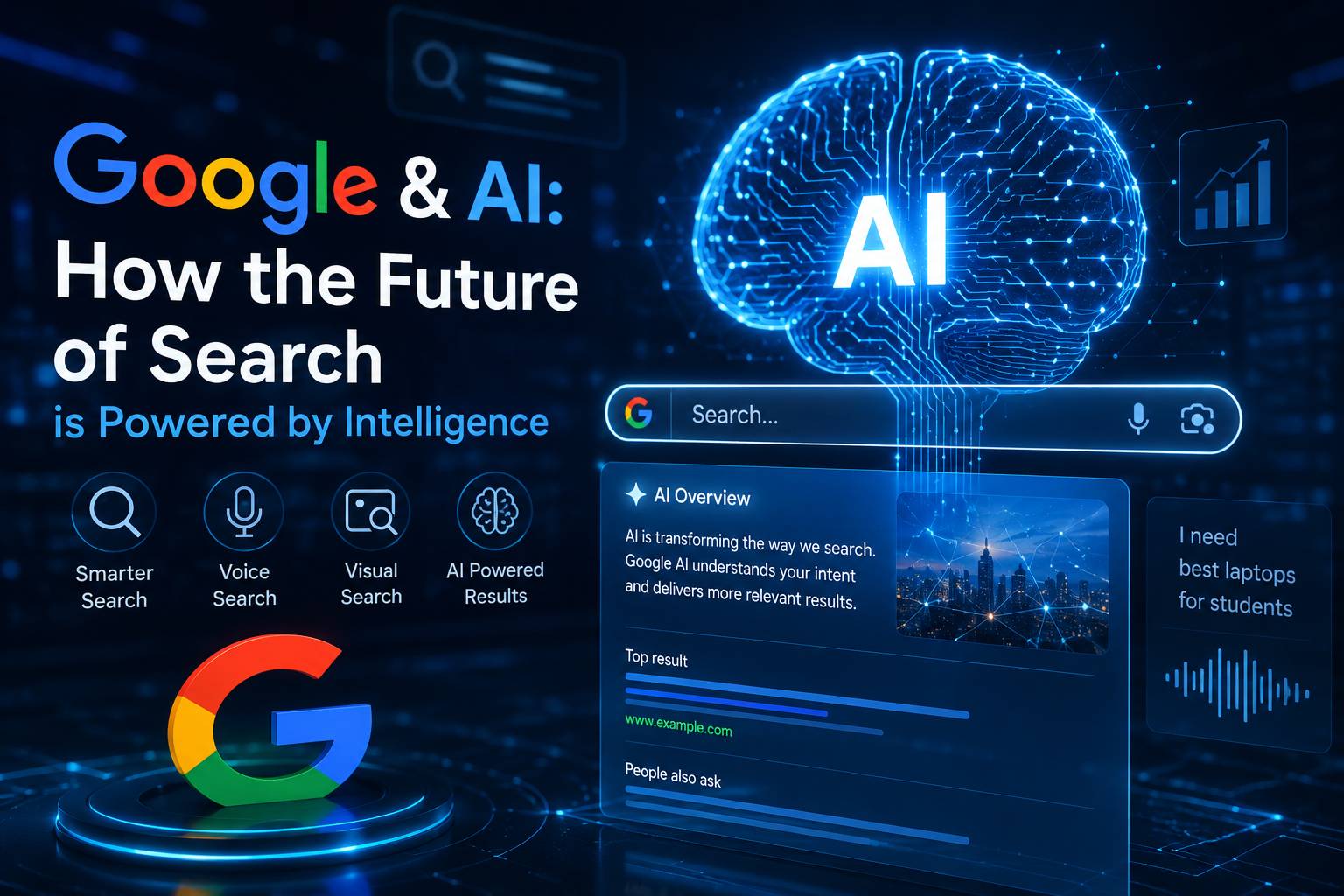
Google AI is changing the way people search online. Search engines are no longer based only on keywords. Google now understands meaning, user intent, images, voice commands, and search behavior using artificial intelligence.
This change is helping users find better results faster. It is also changing SEO, blogging, affiliate marketing, and digital marketing strategies across the internet.
Google uses advanced AI systems like RankBrain, BERT, Gemini, and AI Overviews to improve search quality. These systems help Google understand what users really want instead of matching only exact words.
Businesses, bloggers, marketers, and website owners now need to understand how AI-powered search works if they want better rankings and more traffic.
If you want to improve your SEO knowledge, read this guide about search engine optimization and learn how modern search works.
What is Google AI?
Google AI is a group of artificial intelligence technologies developed by Google AI. These technologies help Google products understand data, language, images, videos, and user behavior.
Google AI powers many services including:
- Google Search
- Google Maps
- Gmail
- YouTube
- Google Lens
- Android
- Google Assistant
Artificial intelligence allows Google to learn from billions of searches every day. This helps the company improve search accuracy and user experience.
Google AI uses several technologies:
| Technology | Purpose |
|---|---|
| Machine Learning | Learns from data |
| Natural Language Processing | Understands human language |
| Neural Networks | Improves prediction systems |
| Computer Vision | Understands images and videos |
| Deep Learning | Processes complex data patterns |
These technologies help Google deliver smarter search results.
How Google Search Worked Before AI
Older search engines mainly depended on keyword matching. If a webpage used the same words typed by the user, it had a better chance of ranking.
This method had many problems:
- Poor understanding of user intent
- Weak voice search support
- Spam keyword stuffing
- Low-quality search results
- Difficulty understanding natural language
AI solved many of these problems.
Now Google can understand search intent even if users type incomplete or confusing queries.
For example:
- “best phone under 300”
- “good mobile for gaming”
- “cheap gaming smartphone”
Google AI understands that all three searches may have similar intent.
RankBrain and the AI Search Revolution
RankBrain was one of Google’s first major AI systems used in search ranking.
It helps Google understand:
- Unknown search queries
- User intent
- Related topics
- Search context
RankBrain studies user behavior and learns which results people prefer.
If users spend more time on a webpage, Google may see it as useful content.
This is why content quality matters more than keyword stuffing.
You can learn more about modern SEO strategies from this guide on on-page SEO techniques.
BERT and Natural Language Understanding
Google introduced BERT to improve natural language understanding.
BERT helps Google understand:
- sentence meaning
- word relationships
- search context
- conversational queries
This made voice search and long-tail searches much better.
For example:
“Can I get medicine for someone at a pharmacy?”
Older systems may not understand the meaning clearly. BERT helps Google understand the full sentence context.
This is important because more users now search using natural language instead of short keywords.
Google Gemini and the Next Generation of AI
Google Gemini is one of Google’s newest AI systems.
Gemini combines:
- text understanding
- image recognition
- coding support
- reasoning abilities
- conversational AI
Gemini powers many AI experiences inside Google products.
It can help users:
- summarize content
- answer questions
- generate ideas
- analyze images
- improve productivity
AI tools are growing fast across the internet. You can also explore these AI tools for bloggers and content creators.
How AI Improves Google Search Results
Artificial intelligence improves search in many ways.
Better Search Intent Understanding
Google now understands why users search for something.
It can identify:
- informational intent
- buying intent
- local intent
- navigational intent
This helps Google show more accurate results.
If someone searches:
“best SEO tools”
Google understands the user wants recommendations instead of dictionary definitions.
Personalized Search Experience
Google AI studies:
- search history
- location
- interests
- device usage
- previous activity
This helps provide personalized search results.
Two users searching the same keyword may see different results.
Local businesses benefit heavily from this technology. Learn more about local SEO for small businesses.
Voice Search and AI
Voice search is growing quickly because of smartphones and smart speakers.
Google AI makes voice search more accurate using:
- speech recognition
- natural language processing
- AI prediction models
Voice searches are usually longer and more conversational.
Example:
- Text search: “weather Delhi”
- Voice search: “What is the weather in Delhi today?”
This change is also affecting SEO keyword strategies.
Google Lens and Visual Search
Google AI can now understand images using computer vision technology.
Google Lens allows users to:
- search products from images
- translate text
- identify plants
- identify landmarks
- copy text from photos
Visual search is becoming more important in eCommerce and content discovery.
Optimizing images matters more than ever. Here is a helpful guide about image optimization for SEO.
AI Overviews in Google Search
Google now displays AI-generated summaries directly in search results.
These AI Overviews provide:
- quick answers
- summarized information
- source references
- topic explanations
This changes how users interact with search engines.
Website owners now need stronger content quality to remain visible in search.
How AI Changes SEO
AI has changed SEO completely.
Older SEO methods focused mainly on:
- exact keywords
- backlinks
- metadata
Modern SEO now focuses more on:
- helpful content
- semantic relevance
- user experience
- topical authority
- search intent
You can improve your SEO knowledge with this guide on semantic SEO.
Semantic SEO and AI Search
Semantic SEO means creating content around topics instead of only keywords.
Google AI understands:
- related phrases
- synonyms
- context
- topic depth
For example, a page about “AI search” may also rank for:
- Google AI
- machine learning search
- intelligent search engine
- future of search
This is why long-form content performs better today.
AI and Content Creation
AI writing tools are becoming popular among bloggers and marketers.
These tools help with:
- idea generation
- content outlines
- SEO optimization
- grammar improvement
Popular AI tools include:
- ChatGPT
- Gemini
- Claude
- Jasper
- Copy.ai
You can explore more tools here:
best free AI content generators
Does Google Penalize AI Content?
Google does not automatically penalize AI-generated content.
Google mainly focuses on:
- usefulness
- originality
- quality
- expertise
- user value
Low-quality spam content is the real problem.
This article explains it clearly:
the truth about AI content and Google rankings
AI and Keyword Research
Artificial intelligence helps marketers discover:
- user intent
- search trends
- related keywords
- topic clusters
Modern keyword research tools use AI to provide better suggestions.
Useful resources:
Best free keyword research tools
10 powerful keyword research tools
Google Trends for high CPC keywords
AI in YouTube Recommendations
YouTube also uses Google AI heavily.
AI helps YouTube:
- recommend videos
- detect spam
- understand watch behavior
- improve ad targeting
Creators can improve visibility using smart SEO strategies.
Helpful guides:
AI in Digital Advertising
AI improves digital advertising by:
- targeting audiences
- improving conversions
- reducing ad waste
- analyzing user behavior
Platforms using AI include:
- Google Ads
- Meta Ads
- YouTube Ads
Publishers can improve earnings using better SEO and AI-driven optimization.
Related guides:
AI and Affiliate Marketing
Affiliate marketers also benefit from AI tools.
AI helps with:
- content ideas
- SEO optimization
- keyword analysis
- email marketing
- audience targeting
Useful resources:
AI and Website Development
AI tools now help developers:
- generate code
- design websites
- build apps
- automate testing
Developers and beginners can create websites faster using AI tools.
Helpful guides:
AI and Technical SEO
Technical SEO is becoming more important because Google AI now studies:
- website speed
- mobile experience
- indexing
- structured data
- crawl quality
Important resources:
AI and Link Building
Backlinks still matter in SEO.
However, Google AI now evaluates:
- link quality
- relevance
- authority
- spam signals
Helpful guides:
Challenges of AI in Search
AI search also creates challenges.
Privacy Concerns
Google collects large amounts of user data.
Many users worry about:
- tracking
- data storage
- personalization
AI Hallucinations
AI systems sometimes generate incorrect information.
This is called hallucination.
Users should always verify important information from trusted sources.
Content Spam
Many websites now publish low-quality AI content quickly.
Google is improving spam detection systems to fight this issue.
The Future of AI Search
The future of search will likely include:
- conversational AI
- multimodal search
- AI assistants
- personalized search journeys
- real-time search answers
Users may search using:
- text
- voice
- photos
- videos
Search engines may become more like intelligent assistants instead of simple search tools.
AI will continue changing:
- SEO
- blogging
- affiliate marketing
- eCommerce
- web development
- digital advertising
Businesses that adapt early will gain stronger visibility online.
Why Businesses Must Adapt to AI Search
Companies that ignore AI trends may lose traffic and customers.
Businesses should focus on:
- quality content
- user experience
- semantic SEO
- mobile optimization
- fast websites
- topical authority
Modern SEO is about helping users instead of only ranking keywords.
This is why AI-friendly content performs better over time.
ARNLWeb Solutions helps businesses improve:
- SEO
- web development
- WordPress optimization
- digital growth
- AI-ready websites
Learn more at ARNLWeb Solutions.
FAQ
Is Google Search powered by AI?
Yes. Google uses AI systems like RankBrain, BERT, and Gemini to improve search results and understand user intent.
What is Google Gemini?
Google Gemini is an advanced AI model developed by Google for text, image, reasoning, and productivity tasks.
Does Google penalize AI-written content?
Google mainly focuses on content quality and usefulness, not whether AI helped create the content.
How does AI improve SEO?
AI improves SEO by helping search engines understand user intent, content quality, and semantic meaning.
What is semantic SEO?
Semantic SEO focuses on topics and user intent instead of exact keyword matching.
Why is voice search important?
Voice search is growing because users prefer natural spoken queries on phones and smart devices.
Final Thoughts
Google AI is changing the future of search rapidly. Search engines are becoming smarter, faster, and more personalized every year.
AI-powered search now understands meaning, behavior, context, images, and conversations. This creates better experiences for users and new opportunities for businesses.
Website owners who focus on quality content, semantic SEO, and user experience will benefit the most from the next generation of AI search.