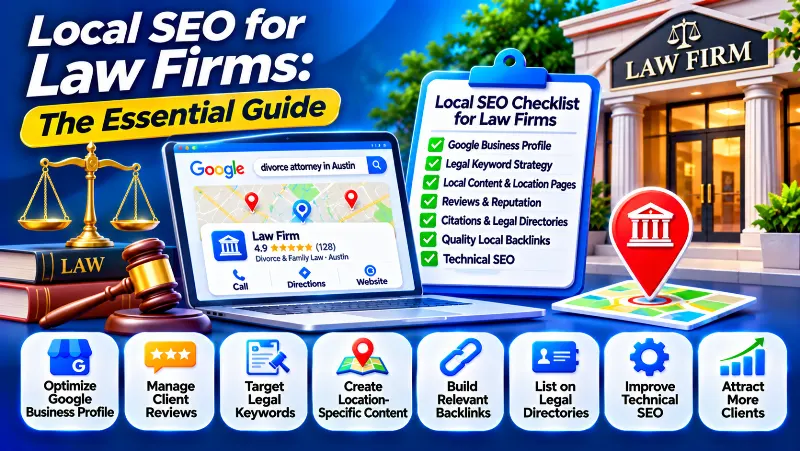
Local SEO for law firms helps attorneys and legal practices become more visible when potential clients search for legal services in a particular location. Whether you specialize in personal injury, family law, criminal defense, immigration, estate planning, or business law, local search optimization can help people discover your practice and understand the services you offer.
However, ranking a law firm website requires more than adding a city name to a page. A successful strategy combines an accurate Google Business Profile, relevant legal keywords, useful practice-area pages, trustworthy business information, genuine client feedback, and a technically sound website.
Legal services are also a sensitive subject. Potential clients need accurate information, professional credibility, and confidence that their personal information will be handled responsibly. This makes content quality, professional experience, confidentiality, and ethical marketing particularly important.
This guide explains how law firms can improve their local search presence, optimize Google Business Profile, research legal keywords, manage online reviews, build relevant backlinks, and monitor campaign performance.
Why Local SEO Matters for Law Firms
People often search online when they need legal assistance. Someone looking for a divorce attorney, accident lawyer, immigration solicitor, or criminal defense attorney may include a city, neighborhood, or nearby location in their search.
For example, a family law practice in Austin may want to be discovered for searches such as “Austin divorce attorney” or “family lawyer in Austin.” These searches can indicate that someone is researching legal services in that area.
Local SEO helps law firms improve their online presence for relevant searches and provide potential clients with useful information about their practice.
| Benefit | Potential Business Impact |
|---|---|
| Local Visibility | Helps potential clients discover the firm through relevant geographic searches. |
| Relevant Website Traffic | Attracts visitors researching legal services in the areas served by the firm. |
| Professional Credibility | Provides clear information about attorneys, practice areas, qualifications, and office locations. |
| Client Enquiries | Can generate consultation requests, calls, and other enquiries. |
| Competitive Opportunities | Allows firms to focus on relevant practice areas and geographic markets. |
| Online Reputation | Helps establish a professional presence through accurate information and genuine feedback. |
Google explains that local results are mainly influenced by three factors:
- Relevance: How closely the firm’s business information matches what someone is searching for.
- Distance: How far the business is from the searcher or the location specified in the search.
- Prominence: How well-known the business is, based on information such as reviews, links, and other online signals.
These factors influence how businesses appear in local search results and Google Maps. A law firm cannot pay Google or request a guaranteed position in the local results.
Another important consideration is the jurisdiction in which an attorney is authorized to practice. Your website should accurately explain the legal services and geographic areas you serve. Do not imply that an attorney is licensed or available to practice in a jurisdiction where that is not the case.
Official reference: Google’s tips to improve local rankings.
Core Components of Local SEO for Law Firms
1. Google Business Profile Optimization
Google My Business is now called Google Business Profile. It allows eligible law firms and individual legal practitioners to manage business information across Google Search and Maps.
A well-maintained profile helps potential clients find important details such as the firm’s address, opening hours, telephone number, website, services, photographs, and reviews.
Use this checklist when reviewing your law firm’s Business Profile:
- Verification: Confirm that the firm or eligible practitioner has claimed and verified the appropriate profile.
- Business Name: Use the genuine real-world business name. Avoid adding practice-area keywords, locations, or promotional phrases that are not part of the established name.
- Address: Provide the firm’s actual eligible office address where clients can visit during stated business hours.
- Contact Information: Check that the telephone number, website, and other contact details are correct.
- Business Categories: Select the most appropriate available category and relevant additional categories.
- Business Description: Explain the firm’s services, professional background, and areas of practice in clear and accurate language.
- Opening Hours: Maintain accurate office hours and update special hours where needed.
- Services: Include relevant practice areas where the Business Profile supports them.
- Photos: Use genuine photographs of the office, meeting areas, attorneys, and professional team members where appropriate.
- Customer Reviews: Establish a compliant process for inviting genuine feedback and managing responses.
Google Business Profiles for Law Firms and Individual Attorneys
Google provides specific Business Profile guidance for individual practitioners, including lawyers. Depending on how a firm is structured, a business profile may represent the law firm, an eligible individual attorney, or both.
Google’s practitioner guidelines explain that an individual lawyer may have a dedicated profile when the lawyer is public-facing and can be contacted directly at the verified location during the stated hours.
For firms with multiple public-facing attorneys at one location, the organization may have its own profile, with eligible individual practitioners having separate profiles. A practitioner’s profile should use the practitioner’s actual name rather than combining the attorney’s name with the firm’s name, except for Google’s specific solo-practitioner arrangement.
A lawyer should not create multiple profiles simply to represent different practice areas. Each profile must meet Google’s eligibility and representation rules.
Also avoid creating profiles for virtual offices or locations that do not meet Google’s requirements. If the practice has multiple genuine offices, manage each eligible location accurately.
Official reference: Google Business Profile guidelines, including individual practitioners.
2. Review Management for Law Firms
Online reviews help prospective clients understand other people’s experiences with a legal practice. They can also contribute to Google’s local prominence signals.
Law firms should manage reviews carefully because a public response can accidentally reveal confidential information about a client or legal matter.
- Request Genuine Feedback: Invite clients to share honest feedback using an appropriate review link.
- Apply the Same Process Fairly: Avoid asking only satisfied clients to leave positive reviews.
- Respond Professionally: Acknowledge feedback without confirming whether someone is or was a client.
- Protect Confidentiality: Never disclose case details, legal advice, private communications, settlement information, or personal information in a public response.
- Address Complaints Carefully: Where necessary, invite the reviewer to contact the office through an appropriate private channel without discussing the matter publicly.
- Report Policy Violations: Report reviews that genuinely violate the platform’s content policies.
Example of a cautious review response:
“Thank you for taking the time to share your feedback. We take professional service and communication seriously. Please contact our office directly if you would like to discuss your concerns.”
This type of response avoids confirming a client relationship or disclosing information about a legal matter.
Never purchase reviews, offer discounts for positive ratings, or pressure clients to write favorable testimonials. Google prohibits fake engagement and incentivized review activity.
Legal ethics requirements also apply. The ABA Model Rule 1.6 addresses confidentiality of information relating to client representation, while the precise rules applicable to a lawyer depend on the jurisdiction in which the lawyer practices.
Official references: Google Maps review policies and ABA Model Rule 1.6: Confidentiality of Information.
3. Local Citations and Legal Directories
Local citations are online mentions of a business and may include its name, address, telephone number, website, and other information. For law firms, relevant legal directories and professional listings can also help potential clients discover attorneys and verify professional information.
Examples of directories and platforms that may be relevant to legal practices include:
- Justia.
- FindLaw.
- Avvo.
- Nolo.
- Super Lawyers.
- Relevant state and local bar association directories.
- Local chambers of commerce and professional organizations.
Not every directory is relevant or suitable for every attorney. Check the platform’s listing requirements, costs, editorial policies, and professional implications before creating a profile or purchasing a placement.
Citation audit checklist:
- Verify the firm’s real-world name.
- Check the office address and telephone number.
- Use the correct website URL.
- Review attorney names and professional designations.
- Correct outdated practice-area descriptions.
- Identify duplicate or obsolete listings.
- Check that directory profiles do not claim qualifications or certifications that the attorneys do not hold.
Keep business information accurate across important platforms. There is no guaranteed number of directory listings that will produce a particular ranking.
For more guidance, explore our article on local SEO optimization.
4. Report Fraudulent Business Listings and Reviews
Law firms may encounter misleading business listings, impersonation attempts, duplicate profiles, or reviews that violate platform policies. These problems can confuse potential clients and damage the firm’s online reputation.
- Report listings that impersonate the firm or misrepresent its identity.
- Request corrections for inaccurate business details.
- Use Google’s available procedures to report policy-violating reviews.
- Keep records of submitted reports and supporting evidence.
- Monitor important legal directory profiles for unauthorized changes.
- Respond to genuine criticism professionally and without disclosing confidential information.
Do not report a review simply because it is negative or critical. A review should be reported when there is a genuine policy violation, not just because the firm disagrees with the customer’s opinion.
Advanced Local SEO Strategies for Law Firms
Google Business Profile Optimization
After completing the basic profile setup, review how effectively it communicates the firm’s services and makes important information available to potential clients.
| Profile Element | Recommended Practice |
|---|---|
| Business Information | Maintain the correct name, address, telephone number, website, and operating hours. |
| Categories | Choose the most accurate available business category. |
| Practice Areas | Describe relevant legal services in the appropriate profile fields. |
| Photographs | Use genuine images of the office, attorneys, and professional team. |
| Updates | Share relevant firm announcements, educational content, and office updates where appropriate. |
| Customer Reviews | Encourage genuine feedback without requesting positive ratings or disclosing client details. |
| Contact Options | Make sure the website and telephone information are correct. |
Business Profile updates can communicate relevant information, but there is no Google requirement to publish a specific number of posts each week. Focus on accuracy and usefulness rather than an arbitrary publishing schedule.
Leveraging Reviews and Testimonials Ethically
Legal services require a high level of professional trust. Reviews and testimonials may help potential clients understand their experience with a firm, but lawyers must consider confidentiality and advertising rules before publishing or responding to them.
Consider these practices:
- Invite genuine feedback without offering incentives.
- Do not pressure clients to leave positive reviews.
- Obtain appropriate informed consent before using identifiable client testimonials or case information where required.
- Do not reveal confidential information in review responses.
- Review testimonials for misleading claims or unsupported guarantees.
- Check whether applicable professional rules require a disclaimer or additional disclosure.
- Monitor listings on relevant legal directories and review platforms.
The ABA Model Rule 7.1 addresses false or misleading communications about a lawyer’s services. Its commentary also explains how statements about previous client results may create unjustified expectations when presented without suitable context.
State and jurisdictional bar rules may differ. Before publishing client testimonials, settlement figures, case results, comparisons, or claims of specialization, have the material reviewed against the professional rules that apply to the firm.
Official reference: ABA Model Rule 7.1: Communications Concerning a Lawyer’s Services.
Review management tools such as Birdeye may help firms monitor feedback across supported platforms. Review the provider’s privacy, data-handling, and contractual terms before using it to manage information connected to client relationships.
Building Authority with Relevant Backlinks
Backlinks are links from external websites to your law firm’s website. Relevant editorial links and professional mentions can help potential clients discover your practice and contribute to the wider online presence of your firm.
For law firms, useful link opportunities may come from reputable legal publications, professional associations, local organizations, universities, and relevant community resources.
For more guidance, read our ultimate guide to high-quality backlinks.
Effective Link-Building Methods for Law Firms
| Strategy | Example |
|---|---|
| Legal Publications | Contribute accurate legal commentary or educational articles to relevant publications. |
| Professional Associations | Maintain legitimate profiles with relevant bar associations and professional organizations. |
| Local Sponsorships | Support genuine community programs and events where the firm has a legitimate relationship. |
| Educational Resources | Publish useful explanations of legal processes and public-facing resources. |
| University and Community Initiatives | Participate in eligible educational programs and community legal awareness projects. |
| Guest Articles | Contribute original, relevant articles to reputable legal and local publications. |
Potential legal publication and professional resources include Law360, the American Bar Association, and relevant state bar publications. Editorial acceptance and contribution requirements vary by publication.
Never select backlink opportunities solely because a third-party SEO tool reports a high Domain Authority score. Such scores are proprietary estimates rather than official Google ranking metrics.
When links are paid or sponsored, follow applicable advertising disclosure and search-engine link qualification requirements. Avoid private link schemes, automated link exchanges, and purchased links intended to manipulate rankings.
Measuring Backlink Performance
Use SEO tools to understand your backlink profile, identify relevant referring websites, and detect changes over time.
| Metric | Useful Tool | What to Review |
|---|---|---|
| Referring Domains | Ahrefs | Relevant websites linking to your firm. |
| Backlink Profile | Google Search Console and Ahrefs | Links discovered by Google and third-party tools. |
| Link Context | Manual review | Whether a link appears in a relevant editorial context. |
| Anchor Text | Ahrefs or Semrush | Whether anchor text accurately describes the destination. |
| Broken Links | Screaming Frog | Broken internal or external destinations. |
Do not judge a backlink solely by its score or domain extension. Assess relevance, legitimacy, editorial context, and whether the link is useful to the audience.
Keyword Strategies for Legal SEO

Keyword research helps law firms understand the language people use when searching for legal assistance. The objective is to identify relevant searches and create pages that answer the questions potential clients actually have.
Primary and Secondary Legal Keywords
Organize legal keywords according to practice area, geographic relevance, and search intent.
| Keyword Type | Example | Suitable Content |
|---|---|---|
| Primary Local Keywords | Personal injury lawyer in Chicago | Personal injury practice page. |
| Practice Area Keywords | Divorce attorney, criminal defense lawyer | Dedicated practice-area pages. |
| Secondary Keywords | Child custody laws, car accident claims | Educational guides and supporting articles. |
| Question-Based Queries | How long does a divorce take in Texas? | Legal information and FAQ content reviewed for accuracy. |
| Commercial Queries | Best immigration lawyer in Austin | Firm information and relevant service pages. |
| Location-Based Searches | Family lawyer near Downtown Austin | Relevant location pages, where appropriate. |
Where to Use Legal Keywords
Use your primary topic and related terminology naturally in relevant page elements:
- Page Titles: Use a clear description of the practice area and location where relevant.
- Main Headings: Explain the specific legal service covered by the page.
- Meta Descriptions: Summarize the information and services available.
- Practice-Area Content: Explain the legal matters the firm handles.
- Internal Links: Connect related practice-area pages, guides, and attorney profiles.
- Image Alt Text: Describe the actual image without forcing legal keywords into decorative images.
For example, a criminal defense practice may use a title such as “Criminal Defense Attorney in Chicago” if that accurately represents the page and the attorney’s authorized practice area.
Avoid repeating the same exact-match keyword in every heading and paragraph. Natural language and clear explanations are more useful than arbitrary keyword-density targets.
For keyword research, explore the ARNLWeb Keyword Research Tool and our guide to the best free keyword research tools.
Localized Content Creation for Law Firms
Legal content should answer genuine questions while accurately reflecting the laws and procedures relevant to the audience. Localized content can help a law firm explain its practice areas, jurisdiction, and services to people in the locations it serves.
Useful legal content ideas include:
- Legal Guides: Explain relevant legal processes, rights, and common questions in the firm’s jurisdiction.
- Practice-Area Articles: Publish educational information about personal injury, family law, estate planning, immigration, or other services offered by the firm.
- Frequently Asked Questions: Answer common questions about consultations, documentation, legal procedures, and available services.
- Local Legal Updates: Explain relevant legislative changes and court procedure updates with accurate dates and references.
- Attorney Profiles: Provide genuine information about professional qualifications, experience, admissions, and practice areas.
- Client Resources: Publish helpful checklists and explanations that help people understand what information they may need before contacting a lawyer.
Examples of article topics:
- “What to Know Before Filing for Divorce in Texas.”
- “Understanding the Personal Injury Claim Process in Florida.”
- “Common Questions About Criminal Defense Representation in Illinois.”
- “Estate Planning Considerations for Families in California.”
These are illustrative content topics. Legal requirements, deadlines, and procedures vary by jurisdiction and can change. Have legal content reviewed by a qualified attorney familiar with the relevant law before publication.
Do not publish fictional settlement stories or invented client testimonials as factual case studies. If your firm publishes information about previous results, make sure it is accurate, properly authorized, and presented without implying that similar results are guaranteed for future clients.
Law firms should also avoid presenting general educational content as individualized legal advice or implying that visiting a website establishes an attorney-client relationship when it does not.
WordPress Integration Tips for Law Firm SEO
Many law firms use WordPress to manage their websites, publish legal guides, and maintain practice-area pages. A properly configured WordPress site can make ongoing SEO management easier.
Follow these practical recommendations:
- Choose a Reliable Theme: Use a responsive and well-maintained WordPress theme. Explore our guide to fast WordPress themes.
- Manage SEO Metadata: Use one properly configured SEO plugin to manage page titles, meta descriptions, canonical URLs, and indexing directives.
- Improve Loading Performance: Configure suitable caching and performance optimization. See our guide to WordPress cache plugins.
- Optimize Images: Compress photographs and use relevant descriptive alt text. Read our guide to image optimization for SEO.
- Organize Practice Areas: Create a clear navigation structure for the firm’s services, attorneys, locations, and educational content.
- Use Structured Data Carefully: Implement suitable Organization, LocalBusiness, or relevant Schema.org types where appropriate. Ensure the markup represents real and visible information.
- Protect Client Information: Avoid publishing sensitive client documents, personal details, or confidential case information through website forms, articles, or public media.
- Monitor Website Health: Review Search Console, indexing, broken links, backups, and website security regularly.
Legal-service structured data is available in the Schema.org vocabulary as a subtype of LocalBusiness. Google also documents LocalBusiness structured data. Use appropriate markup only when the page accurately represents the business, and do not assume that schema guarantees a special search appearance or better rankings.
Official reference: Google Local Business structured data and Schema.org LegalService.
For more WordPress guidance, explore our WordPress resources and our guide to technical SEO foundations.
Measuring Local SEO Performance for Law Firms
After implementing your local SEO strategy, monitor whether it is helping potential clients discover the firm and take meaningful actions. Rankings and website traffic are useful indicators, but they should not be the only measures of success.
Important metrics include:
- Google Business Profile Performance: Monitor profile views, searches, website clicks, calls, and other available customer interactions.
- Organic Search Visibility: Use Google Search Console to review relevant queries, impressions, clicks, and landing pages.
- Website Engagement: Use analytics to understand how visitors interact with practice-area pages and attorney profiles.
- Qualified Enquiries: Measure relevant consultation requests, telephone enquiries, and contact-form submissions.
- Conversion Quality: Evaluate whether enquiries are relevant to the firm’s practice areas and geographic scope.
- Reputation Management: Monitor genuine reviews and professional responses across relevant platforms.
Use Google Search Console, Google Analytics, and the Business Profile performance reports to understand different parts of the customer journey.
For legal practices, lead measurement should also respect privacy and confidentiality. Do not send sensitive case details or privileged information to analytics platforms. Configure contact forms and tracking so that private information is not unnecessarily collected or shared.
Legal Advertising and Professional Ethics: Important Considerations
Law firm SEO is different from marketing many other types of businesses because communications about legal services are subject to professional conduct requirements.
For example, the American Bar Association’s Model Rules provide guidance on communications about a lawyer’s services, advertising, and confidentiality. Individual states and jurisdictions may adopt different versions or additional requirements, so firms should verify the rules that apply to their practice.
Pay particular attention to these areas:
- Truthful Marketing: Avoid false claims, misleading comparisons, unsupported success rates, and guarantees of legal outcomes.
- Case Results: Do not imply that a previous settlement or verdict guarantees similar results for another client.
- Confidentiality: Protect information relating to client representation, including information that could identify a client or reveal a legal matter.
- Testimonials: Review consent, disclosure, and advertising requirements before publishing client endorsements.
- Professional Designations: Only claim specialist certification when the relevant jurisdiction permits the designation and applicable requirements are satisfied.
- Referral Arrangements: Review professional rules before paying for recommendations, referrals, or lead-generation arrangements.
- Disclaimers: Include appropriate notices when required, such as attorney advertising disclosures or explanations that website content is general information.
The ABA Model Rules are not automatically binding in every jurisdiction. Lawyers must check the professional rules adopted by the state, territory, or country where they practice.
Official references:
- ABA Model Rule 7.1: Communications Concerning a Lawyer’s Services.
- ABA Model Rule 7.2: Communications Concerning a Lawyer’s Services.
- ABA Model Rule 1.6: Confidentiality of Information.
This article covers SEO and marketing practices, not legal advice about advertising compliance. Have final marketing materials reviewed by a lawyer familiar with the relevant professional conduct rules.
Frequently Asked Questions About Local SEO for Law Firms
What is local SEO for law firms?
Local SEO for law firms is the process of improving a legal practice’s online presence for relevant searches in the geographic areas it serves. It includes Google Business Profile optimization, legal keyword research, practice-area content, citations, reviews, backlinks, and website improvements.
Does every law firm need a Google Business Profile?
Eligible law firms and individual public-facing legal practitioners can use Google Business Profile. The firm must meet Google’s requirements for a genuine business location or eligible service-area operation. Virtual offices and misleading addresses should not be used to create profiles.
Are client reviews important for law firm SEO?
Reviews can contribute to local prominence and help potential clients evaluate a firm. However, firms must manage feedback in a way that respects confidentiality and applicable advertising rules. Never purchase reviews or disclose private case information in public responses.
Should every attorney have a separate Google Business Profile?
No. Google has specific rules for individual practitioners. A public-facing lawyer who can be contacted directly at a verified location during stated hours may qualify for an individual profile. Follow the guidelines for multiple practitioners and solo practitioners within branded organizations.
What keywords should a law firm target?
Choose keywords that reflect the firm’s actual practice areas and geographic scope. Examples include personal injury lawyer in Chicago, divorce attorney in Austin, and estate planning lawyer in Miami. Include relevant educational questions and supporting topics where they serve potential clients.
How can a law firm build quality backlinks?
Develop relevant professional relationships, contribute useful legal commentary, participate in legitimate community programs, maintain professional directory listings, and publish informative resources that other reputable websites may reference.
Can a law firm guarantee first-place Google rankings?
No. Google controls its search ranking systems, and local results depend on relevance, distance, prominence, competition, and other contextual factors. Be cautious of agencies promising guaranteed positions or a specific number of new clients.
How long does local SEO take for a law firm?
There is no guaranteed timeline. Results depend on the firm’s starting online presence, local competition, practice area, website condition, and the work being implemented. Track progress over time rather than relying on a fixed ranking deadline.
Final Thoughts: Build a Strong Local Presence for Your Law Firm
Local SEO can help law firms become more visible when potential clients search for relevant legal services. An accurate Google Business Profile, useful practice-area pages, relevant local keywords, genuine reviews, professional citations, and trustworthy backlinks all contribute to a stronger online presence.
Start by confirming your business information, attorney profiles, and practice areas. Then build helpful legal content, maintain relevant listings, manage reviews responsibly, and improve the website’s technical performance.
Most importantly, make sure your marketing reflects the professional obligations of your practice. Protect client confidentiality, avoid misleading claims, and review advertisements and testimonials against the rules that apply in your jurisdiction.
For more practical guidance, explore our local SEO optimization guide, local SEO services, and high-quality backlink guide.
At ARNL Web Solutions, we believe that effective local SEO for law firms should do more than improve rankings. It should help the right people discover relevant legal services, understand the firm’s experience, and make informed decisions about contacting a qualified attorney.