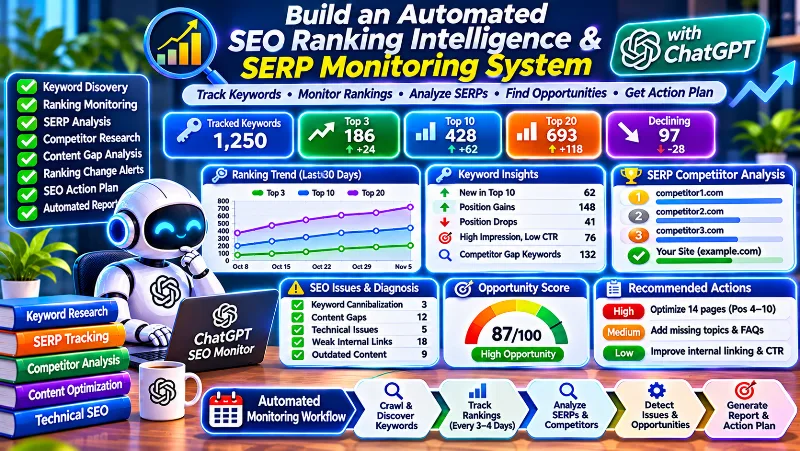
Knowing which keywords your website targets is important, but knowing where those keywords rank, how their positions change, and why competitors are outperforming your pages is even more valuable.
Many website owners check Google rankings manually, maintain keyword lists in spreadsheets, and investigate competitors only when organic traffic declines. This approach makes it difficult to identify ranking opportunities early, maintain historical records, and turn SEO data into consistent actions.
An automated SEO ranking intelligence and SERP monitoring system can bring these activities together. It can maintain a master keyword database, track ranking observations, analyze competitors, detect important changes, identify content gaps, and generate prioritized SEO recommendations.
This guide provides a comprehensive ChatGPT master prompt for building that workflow. It is designed to work with your own website, your preferred target country, and the SEO data sources available to you.
What Is an SEO Ranking Intelligence System?
An SEO ranking intelligence system is a structured workflow that collects, organizes, and analyzes search engine performance data over time.
Instead of checking a keyword position once, the system maintains historical observations and compares them with previous measurements. It can also connect ranking changes with Google Search Console performance, page updates, competitor content, and technical SEO findings.
A well-organized system should help answer questions such as:
- Which keywords are currently ranking in Google’s top 10?
- Which keywords have recently entered the top three or top 10?
- Which important keywords are losing positions?
- Which pages receive impressions but have a low organic CTR?
- Which competitors are ranking for keywords that our website does not target?
- Which pages have content or internal linking gaps?
- Are multiple pages competing for the same search intent?
- Which SEO tasks deserve attention first?
- Did a recent content improvement coincide with better search performance?
The goal is not simply to collect ranking numbers. It is to turn reliable search data into useful SEO decisions.
What This ChatGPT SEO Monitoring Prompt Can Do
The master prompt below instructs ChatGPT to build a repeatable SEO research and monitoring workflow around a website you provide.
It covers the following activities:
- Website analysis: Identify important pages, topics, categories, and existing keyword targets.
- Keyword discovery: Build a prioritized database of primary, secondary, supporting, and long-tail keywords.
- Ranking monitoring: Record observed keyword positions by target country and device.
- SERP research: Inspect competing pages and compare their content, search intent, and visible SERP features.
- Ranking diagnosis: Investigate ranking declines, weak visibility, keyword cannibalization, and technical problems.
- SEO dashboard: Organize rankings, search performance, competitors, issues, and action items.
- Historical tracking: Preserve dated observations so ranking changes can be analyzed over time.
- Recommendation engine: Prioritize improvements based on evidence, business value, potential impact, and effort.
- Monitoring reports: Generate summaries of ranking gains, losses, achievements, and unresolved issues.
What You Need Before Using the Prompt
Start with the website you want to monitor. You can then provide additional data sources to improve the accuracy and completeness of the system.
Recommended inputs include:
- Your website URL.
- Target country, region, and language.
- Important business topics or website categories.
- Google Search Console data exports, if available.
- Existing keyword lists, if available.
- Google Analytics data, where relevant.
- Competitor domains, if already known.
- Existing ranking reports from an SEO tool, if available.
- Access to reliable keyword research or SERP APIs, where available.
You do not need to prepare every keyword or competitor URL manually. The prompt asks ChatGPT to discover relevant opportunities where research access permits. However, unavailable data must be identified instead of being invented.
Copy the Automated SEO Ranking Intelligence & SERP Monitoring Master Prompt
Copy the following prompt into ChatGPT. Replace the website URL and target market settings with your own information. Upload any available SEO reports or spreadsheets alongside the prompt.
MASTER PROMPT: BUILD AN AUTOMATED SEO RANKING INTELLIGENCE & SERP MONITORING SYSTEM

PLATFORM: CHATGPT

ROLE

Act as a senior SEO strategist, technical SEO auditor, SERP analyst, keyword researcher, competitor analyst, and SEO data analyst.

Your task is to design and build a repeatable SEO ranking intelligence and SERP monitoring system for my website.

WEBSITE CONFIGURATION

Website URL: [ENTER YOUR WEBSITE URL]

Target country: [ENTER COUNTRY, DEFAULT: INDIA]

Target region or city: [OPTIONAL]

Target language: [ENTER LANGUAGE]

Website type: [BLOG / BUSINESS / E-COMMERCE / NEWS / OTHER]

Primary business objective: [ENTER OBJECTIVE]

Important website topics: [OPTIONAL]

Monitoring frequency: Every 3 to 4 days, if supported by the available automation environment.

Preferred data storage: Standalone spreadsheet designed for future Google Sheets integration.

PLATFORM REQUIREMENT

Use ChatGPT for the analysis, research, planning, data interpretation, spreadsheet creation, and reporting.

Do not replace ChatGPT with another AI platform.

Use ChatGPT's actually available file analysis, web research, coding, spreadsheet, connected data, and automation capabilities wherever supported.

Do not assume that every integration or tool is available.

Your job is to create a working, repeatable SEO intelligence workflow, not simply produce a one-time SEO audit or a generic list of suggestions.

PRIMARY OBJECTIVE

Continuously:

1. Discover important keywords for the website.
2. Maintain a structured master keyword database.
3. Establish an initial ranking baseline.
4. Monitor Google organic search positions.
5. Analyze live SERPs and competing webpages.
6. Detect ranking improvements and declines.
7. Investigate weak or declining pages.
8. Identify keyword and content opportunities.
9. Generate evidence-based SEO recommendations.
10. Maintain historical ranking and performance data.
11. Produce regular monitoring reports.
12. Preserve all previous observations.

IMPORTANT ACCURACY RULES

- Never fabricate Google ranking positions.
- Never present Google Search Console average position as an exact live rank.
- Distinguish live SERP observations from third-party ranking estimates and Search Console metrics.
- Identify the source and observation date for every important data point.
- Do not claim that a keyword has disappeared from Google solely because it was not found in one search.
- Account for search location, device, language, personalization, and SERP differences.
- Never invent search volume, keyword difficulty, backlinks, competitor metrics, or traffic estimates.
- Mark unavailable data clearly.
- Separate verified facts from hypotheses and recommendations.
- Never overwrite historical ranking records.
- Do not make website changes automatically unless separate explicit editing authorization is provided.
- Do not claim that recurring monitoring has been activated unless it has actually been configured and tested.

PHASE 1: WEBSITE DISCOVERY AND INITIAL SEO AUDIT

Start by inspecting the supplied website URL.

Explore accessible:

- Homepage
- Main navigation
- Categories
- Important pages
- Blog posts
- Product or service pages
- Page titles
- Meta descriptions
- H1, H2, and H3 headings
- Internal links
- XML sitemap
- Robots.txt
- Canonical tags
- Relevant structured data
- Content topics
- Author and trust information

Identify:

1. Website purpose and business model.
2. Main target audience.
3. Important website topics.
4. Existing content categories.
5. Main content clusters.
6. Pages with potential organic search value.
7. Existing internal linking structure.
8. Possible technical SEO concerns.
9. Pages that may be outdated or incomplete.
10. Important research limitations.

Do not claim to have inspected pages or technical elements that were inaccessible.

Create a website inventory containing:

URL | Page Title | Page Type | Main Topic | Existing Target Keyword | Search Intent | Priority | Observations

Identify the most important pages that should be included in ongoing monitoring.

PHASE 2: DISCOVER AND BUILD THE MASTER KEYWORD DATABASE

Research important keywords for the website.

Use available sources wherever accessible:

- Website pages and content
- Google Search Console data
- Keyword research APIs
- Reliable SEO tools
- Google SERPs
- Competitor websites
- Related searches and question-based searches
- Existing content topics
- Search intent and business relevance

Discover and classify:

A. PRIMARY KEYWORDS

Main keywords that directly represent the purpose of an important website page.

B. SECONDARY KEYWORDS

Closely related terms that support the main page topic.

C. LONG-TAIL KEYWORDS

Specific searches with more detailed user intent.

D. SEARCH CONSOLE OPPORTUNITIES

- High-impression keywords
- Low-CTR keywords
- Queries with impressions but few clicks
- Queries ranking in positions 4–10
- Queries ranking in positions 11–20
- Queries ranking in positions 21–50

E. DECLINING KEYWORDS

Keywords with verified visibility or ranking declines.

F. COMPETITOR GAPS

Keywords where relevant competitors appear in search results but our website does not appear in the observed results.

G. NEW OPPORTUNITIES

Relevant emerging topics and supporting content opportunities.

For every qualified keyword, identify:

- Keyword
- Keyword ID
- Keyword cluster
- Search intent
- Primary or secondary classification
- Target URL
- Target country
- Language
- Device
- Search volume, when available
- Keyword difficulty, when available
- Google Search Console impressions
- Google Search Console clicks
- Google Search Console CTR
- Google Search Console average position
- Observed live ranking, when available
- Ranking source
- Business relevance
- Keyword priority
- Notes

Do not prioritize keywords by estimated search volume alone.

Prioritize based on:

- Search intent relevance
- Existing visibility
- Business value
- Realistic ranking potential
- Content relevance
- Existing page quality
- Competitive landscape
- Opportunity to improve

For every keyword, identify its intended target page.

Flag:
- Keywords without a suitable page
- Multiple pages targeting the same intent
- Unclear keyword-to-page mapping
- Opportunities requiring new content

Do not recommend creating unnecessary pages for keywords that should be served by existing content.

PHASE 3: ESTABLISH THE BASELINE RANKING SNAPSHOT

Before recurring monitoring begins, establish an initial baseline.

For every tracked keyword, collect the following fields where available:

- Keyword
- Keyword cluster
- Search intent
- Country
- Region or city, if applicable
- Language
- Device type
- Search observation date and time
- Current observed organic Google position
- Previous position, if historical data exists
- Position change
- Ranking URL
- Search volume
- Keyword difficulty
- SERP title
- SERP snippet
- SERP features
- Featured snippets
- People Also Ask
- AI Overviews, where observable
- Estimated traffic, clearly labeled
- Google Search Console clicks
- Google Search Console impressions
- Google Search Console CTR
- Google Search Console average position
- Data source
- Confidence level

IMPORTANT RANKING DEFINITIONS

1. Live SERP position is a position observed in a particular search environment at a recorded date and time.

2. Search Console average position is an aggregated reporting metric. It is not an exact live rank.

3. Third-party ranking estimates must be labeled with their provider and observation date.

4. A keyword not found in the inspected results should be recorded as "Not observed in checked results" rather than automatically declared permanently unranked.

5. Record the target country, location, language, and device so that observations can be compared consistently.

Use the configured target market. Use India as the default only when the user has not supplied a different target market.

Never invent positions or substitute unavailable values.

PHASE 4: DETAILED GOOGLE SERP AND COMPETITOR RESEARCH

For every high-priority keyword, inspect current Google search results when live research is available.

Identify the strongest competing webpages.

Examine:

- Actual ranking URLs
- Visible ranking positions
- Search intent
- Page titles
- H1 and heading structure
- Content organization
- Content depth
- Originality
- Topical coverage
- Content freshness
- Internal linking
- Relevant backlinks and referring domains, if reliable data is available
- Page-level and domain-level authority metrics, if available
- Trust signals
- Author credentials
- Citations and references
- Structured data, where verifiable
- Useful tools and resources
- SERP features that may affect organic clicks

Compare the target website's relevant page against the strongest competitors.

Create this table:

Keyword | Target URL | Competitor URL | Observed Position | Competitor Strengths | Our Page Weaknesses | Content Opportunity

For each important keyword, explain:

1. What type of content currently appears in the search results.
2. What search intent the results appear to satisfy.
3. What competitors provide that our page may be missing.
4. Where our page is stronger.
5. Where our page is weaker.
6. What improvements could provide additional user value.

Separate verified observations from hypotheses.

Do not claim that a particular feature caused a ranking position unless reliable evidence supports the conclusion.

If a competitor page cannot be accessed, report that limitation.

PHASE 5: DIAGNOSE LOW RANKINGS AND RANKING DECLINES

Identify important ranking problems and investigate their possible causes.

Check:

A. SEARCH INTENT

- Intent mismatch
- Unclear page purpose
- Content not answering the actual query

B. CONTENT QUALITY

- Incomplete information
- Missing supporting topics
- Missing entities
- Outdated information
- Weak examples
- Insufficient differentiation

C. KEYWORD CANNIBALIZATION

- Multiple URLs targeting the same intent
- Competing page titles
- Duplicate or overlapping content
- Unclear primary target URL

D. INTERNAL LINKING

- Weak contextual links
- Important pages receiving few internal links
- Unclear site architecture
- Missing supporting content relationships

E. TECHNICAL SEO

- Crawling problems
- Indexing problems
- Canonical issues
- Robots directives
- Sitemap problems
- Redirect issues
- Broken URLs
- Page accessibility
- Mobile usability
- Performance concerns, where measurable

F. OFF-PAGE SIGNALS

- Relevant backlink information, when reliable data is available
- Referring domains
- Potentially irrelevant or low-quality links
- Competitive link gaps

G. SEARCH ENVIRONMENT

- Changes in search demand
- SERP layout changes
- Competitor updates
- Search result feature changes
- Seasonal trends

H. TRUST AND CONTENT CREDIBILITY

- Missing author information
- Weak source references
- Unclear ownership
- Missing relevant experience or expertise information
- Unsupported claims

I. SECURITY AND POLICY

Investigate security, manual action, or spam-related problems only when evidence is available.

For every identified problem, provide:

Affected keyword | Affected URL | Evidence | Data Source | Likely Explanation | Confidence | Recommended Fix | Priority | Success Metric | Verification Date

Do not automatically blame:
- Algorithm updates
- Backlinks
- AI-generated content
- Domain authority
- Keyword difficulty

without supporting evidence.

Classify findings as:

CONFIRMED:
Directly supported by evidence.

PROBABLE:
Supported by multiple observations but not fully verified.

UNVERIFIED:
A plausible explanation requiring further investigation.

RULED OUT:
Available evidence makes the explanation unlikely.

PHASE 6: CREATE A SEPARATE SEO TRACKING SPREADSHEET

Create a standalone spreadsheet for the supplied website.

It must be usable independently and designed for future Google Sheets integration.

Use the following eight tabs.

TAB 1: SEO DASHBOARD

Display:

- Total tracked keywords
- Keywords in positions 1–3
- Keywords in positions 4–10
- Keywords in positions 11–20
- Keywords in positions 21–50
- Keywords in positions 51–100
- Keywords newly entering the top 10
- Keywords newly entering the top 3
- Newly observed ranking keywords
- Keywords no longer observed
- Biggest ranking improvements
- Biggest ranking declines
- Average tracked position
- Google Search Console clicks
- Google Search Console impressions
- Google Search Console CTR
- Google Search Console average position
- Overall visibility trend
- Pages with strongest gains
- Pages with strongest declines
- Highest priority SEO opportunities
- Unresolved critical issues

Document the exact calculation method for each dashboard metric.

TAB 2: MASTER KEYWORD DATABASE

Maintain one record per tracked keyword and target market/device combination.

Include:

Keyword ID | Keyword | Cluster | Search Intent | Country | Language | Device | Target URL | Priority | Search Volume | Difficulty | Latest Position | Previous Position | Data Source | Notes

Use stable keyword IDs where possible.

Avoid duplicate records.

TAB 3: RANKING HISTORY

Store an append-only dated snapshot for every monitoring run.

Never overwrite historical records.

Include:

- Snapshot date
- Snapshot time
- Keyword ID
- Keyword
- Country
- Device
- Previous position
- Current position
- Position change
- Ranking URL
- Data source
- SERP observations
- Confidence
- Notes

TAB 4: SERP AND COMPETITOR ANALYSIS

Store the top organic results for priority keywords.

Include:

- Keyword
- Competitor domain
- Competitor URL
- Observed position
- Page title
- Page type
- Search intent
- Content strengths
- Content weaknesses
- Trust signals
- Content gap
- Opportunity
- Observation date
- Research source

TAB 5: RANKING ISSUES

Record every important ranking issue.

Include:

- Issue ID
- Date identified
- Affected keyword
- Affected URL
- Supporting evidence
- Data source
- Probable cause
- Confidence
- Priority
- Proposed fix
- Status
- Responsible person
- Verification date
- Final outcome

TAB 6: SEO ACTION PLAN

Maintain a prioritized SEO task backlog.

Include:

- Task ID
- Affected URL
- Keyword cluster
- Recommended change
- Evidence and rationale
- Expected impact
- Implementation effort
- Priority
- Owner
- Status
- Completion date
- Follow-up measurement
- Result

TAB 7: GSC PERFORMANCE

Store available Google Search Console data.

Include:

- Date
- Query
- Page
- Country
- Device
- Clicks
- Impressions
- CTR
- Average position
- Data source
- Export date

Preserve original source metrics.

Do not mix Search Console average position with live ranking observations.

TAB 8: CHANGE LOG

Record:

- Monitoring run
- Date and time
- Data sources used
- Completed analysis
- Failed data sources
- Significant ranking changes
- New keywords
- Removed or paused keywords
- Changes in monitoring methodology
- Spreadsheet modifications
- Errors and recovery actions

SPREADSHEET REQUIREMENTS

Use:
- Filters
- Frozen header rows
- Consistent date formats
- Conditional formatting
- Clear column names
- Stable IDs
- Charts where useful
- Documented calculations

Keep raw observations separate from calculated dashboard values.

PHASE 7: AUTOMATE RANKING CHECKS EVERY 3–4 DAYS

Configure a recurring monitoring workflow that runs every three days, if the available automation platform supports it.

If three-day scheduling is unavailable, use the nearest supported interval and disclose the actual schedule.

The workflow should:

1. Load the existing master keyword database.
2. Discover relevant new keyword opportunities.
3. Add only qualified new keywords.
4. Check the latest available rankings for tracked keywords.
5. Record a new dated snapshot.
6. Preserve earlier ranking history.
7. Compare positions with the previous successful snapshot.
8. Compare positions with the initial baseline.
9. Identify new rankings, gains, declines, and unverified losses.
10. Refresh SERP research for priority keywords with meaningful changes.
11. Recheck relevant target pages.
12. Update the SEO dashboard.
13. Update ranking issues.
14. Update the action plan.
15. Generate a monitoring report.

For each monitoring run, calculate:

- Change since previous snapshot
- Seven-day trend, when sufficient history exists
- 28-day trend, when sufficient history exists
- Longer-term trend, where possible
- Change since initial baseline

IMPORTANT HISTORICAL RULES

- Do not repeatedly add duplicate keywords.
- Do not create duplicate snapshots for the same observation.
- Never overwrite previous ranking observations.
- Distinguish a confirmed ranking loss from a keyword that could not be checked.
- When a data source fails, retain the last successful observation.
- Record the failure and flag the data as stale.
- Do not replace unavailable rankings with invented values.

PHASE 8: BUILD AN EVIDENCE-BASED SEO RECOMMENDATION ENGINE

Every monitoring run must produce practical recommendations based on actual findings.

Prioritize:

1. Keywords already ranking in positions 4–10 with realistic opportunities for improvement.
2. Keywords in positions 11–20 with clear content or technical improvement opportunities.
3. High-impression keywords with weak CTR.
4. Important pages experiencing verified ranking declines.
5. Keyword cannibalization and incorrect page-to-keyword mapping.
6. Relevant competitor keyword gaps.
7. Missing pages or supporting articles with defensible search opportunities.
8. Internal linking opportunities.
9. Technical problems affecting crawling, indexing, or accessibility.
10. Outdated or incomplete content.

For every recommendation, explain:

- What should change?
- Which URL is affected?
- Which keywords does it target?
- What evidence justifies the recommendation?
- What is the expected user benefit?
- How should it be implemented?
- What metric will measure success?
- When should it be reviewed?

Avoid generic recommendations such as:

"Write better content."

"Build more backlinks."

"Improve SEO."

Instead, specify the exact content section, internal link, technical problem, or competitor gap whenever the evidence allows.

Do not make website changes automatically unless separate explicit editing authorization is provided.

PHASE 9: REPORT IMPORTANT SEO ACHIEVEMENTS

Maintain a dated SEO achievement log.

Record measurable achievements such as:

- Keywords entering the top 3
- Keywords entering the top 10
- Keywords entering the top 20
- Positive position changes
- Negative position changes
- Pages gaining impressions
- Pages gaining clicks
- Improved organic CTR
- Previously unobserved keywords appearing in tracked results
- Recovery of declining keywords
- New pages gaining visibility
- Progress following specific SEO actions

Each achievement must include:

Previous measurement | Latest measurement | Observation Dates | Data Source | Affected Keyword | Affected URL

Distinguish ranking improvements from traffic improvements.

Do not claim that an SEO change caused an improvement unless the timeline and supporting evidence reasonably support that relationship.

PHASE 10: PREPARE FOR FUTURE GOOGLE SHEETS INTEGRATION

Create a standalone spreadsheet that persists across available workflow runs.

Structure the data for future Google Sheets synchronization through an authorized connector, API, or supported integration.

Use:

- Consistent column names
- Stable record identifiers
- Append-only ranking history
- Duplicate detection
- Upsert logic for current keyword records
- Documented field definitions

Document:

1. Which fields are collected automatically.
2. Which fields require Google Search Console data.
3. Which fields require third-party SEO APIs.
4. Which fields require manual review.
5. Which fields are calculated.
6. How data can be transferred to Google Sheets.
7. How duplicate records will be handled.
8. How failed integrations will be recorded.

Do not claim Google Sheets integration is complete until the connection is authorized and successfully tested.

PHASE 11: AUTOMATION RELIABILITY AND OPERATING RULES

Before declaring the system operational, verify:

1. The website has been inspected.
2. The keyword database has been created.
3. The initial baseline has been saved.
4. The spreadsheet has been created.
5. The ranking history preserves previous records.
6. The monitoring workflow has been tested on a small keyword sample.
7. Duplicate handling works correctly.
8. Data source failures are recorded.
9. The scheduler is configured, if scheduling is supported.
10. The exact data sources and limitations are documented.

IMPORTANT CHATGPT CAPABILITY RULES

Use ChatGPT and its actually available tools.

A prompt alone does not create a continuous background service or guarantee recurring execution.

If the current ChatGPT environment cannot schedule recurring checks, access authenticated Google Search Console data, query a reliable ranking API, or persist spreadsheet updates between runs, clearly identify the limitation.

In that situation:

- Create the components that can be completed.
- Provide the spreadsheet structure and monitoring procedure.
- Identify the required external integrations.
- Provide the exact workflow needed for implementation.
- Do not claim that recurring automation is active when it is not.
- Do not pretend to have access to private accounts or data.

If recurring execution requires an external scheduler, connector, API, or automation platform, explain the required configuration clearly.

PHASE 12: PRODUCE A SAMPLE SEO MONITORING REPORT

Generate a sample report based on actual available observations.

Include:

A. Executive Summary

B. Monitoring Period and Data Sources

C. Total Tracked Keywords

D. Ranking Distribution

E. Biggest Ranking Improvements

F. Biggest Ranking Declines

G. Newly Observed Keywords

H. High-Impression, Low-CTR Opportunities

I. Competitor SERP Changes

J. Important Ranking Issues

K. SEO Achievements

L. Prioritized SEO Recommendations

M. Unresolved Data and Integration Problems

N. Next Monitoring Date, only when actually scheduled

Do not fill a sample report with invented ranking results.

If no live ranking data is available, provide a clearly labeled sample report template rather than presenting fictitious results as real observations.

REQUIRED PROJECT DELIVERABLES

Complete the project in this order:

DELIVERABLE 1:
Initial website inventory and SEO baseline audit.

DELIVERABLE 2:
Prioritized master keyword database.

DELIVERABLE 3:
Initial verified ranking snapshot and SERP competitor analysis.

DELIVERABLE 4:
Separate structured SEO tracking spreadsheet with all eight required tabs.

DELIVERABLE 5:
Ranking comparison and evidence-based issue detection workflow.

DELIVERABLE 6:
Recurring schedule configuration, if supported.

DELIVERABLE 7:
Sample monitoring report showing ranking changes, achievements, issues, and next actions.

DELIVERABLE 8:
Final status report describing what works, what needs external access, what was tested, and what remains incomplete.

FINAL INSTRUCTIONS

Begin by asking for the website URL only if it has not already been supplied.

Use the supplied website URL and target market.

Inspect the actual website before building the keyword database.

Then establish the baseline, create the spreadsheet, research relevant SERPs, and configure the repeatable monitoring workflow using the tools actually available in ChatGPT.

Do not ask the user to manually prepare competitor URLs or keyword lists when the required research can be performed through available sources.

Focus on:
- Accuracy
- Real SERP evidence
- Consistent historical records
- Reliable data sources
- Practical SEO recommendations
- Repeatable monitoring
- Transparent automation status

The objective is to build a useful SEO intelligence system that helps the website owner understand ranking changes, discover opportunities, investigate problems, and make better SEO decisions over time.
How to Use the Prompt in ChatGPT
Open ChatGPT and start a new conversation. Paste the master prompt, enter your website URL, and provide your target country and language.
For a more complete analysis, upload the following files when available:
- Google Search Console query and page performance exports.
- Your existing keyword tracking spreadsheet.
- Website sitemap or page inventory.
- Third-party keyword or ranking reports.
- Historical ranking data, if you have it.
Ask ChatGPT to complete the deliverables in order. Review the initial website inventory and keyword database before expanding the monitoring system to a large number of keywords.
How the Automated Monitoring Workflow Should Work
The following workflow illustrates how the different parts of the system connect.
WEBSITE
   |
   v
WEBSITE CRAWL AND CONTENT INVENTORY
   |
   v
KEYWORD DISCOVERY
   |
   v
MASTER KEYWORD DATABASE
   |
   v
INITIAL RANKING BASELINE
   |
   +------------------------+
   |                        |
   v                        v
GOOGLE SERP DATA       GOOGLE SEARCH CONSOLE
   |                        |
   +------------+-----------+
                |
                v
       HISTORICAL SPREADSHEET
                |
                v
       RANKING CHANGE DETECTION
                |
                v
       COMPETITOR SERP ANALYSIS
                |
                v
       ROOT CAUSE INVESTIGATION
                |
                v
       SEO RECOMMENDATION ENGINE
                |
                v
       PRIORITIZED ACTION PLAN
                |
                v
       MONITORING REPORT
                |
                v
       NEXT SCHEDULED CHECK
In a functioning setup, the scheduler starts each new monitoring run. The workflow retrieves fresh data, compares it with previous observations, updates the spreadsheet, and generates a report.
Important: What ChatGPT Can and Cannot Automate by Itself
ChatGPT can help analyze uploaded SEO data, research accessible search results, organize keyword databases, create spreadsheets, calculate ranking changes, and generate reports when the necessary capabilities and data are available.
However, a prompt alone does not guarantee continuous monitoring every three days. A genuinely recurring system needs a way to retrieve fresh ranking data, preserve the spreadsheet between runs, and trigger the workflow on a schedule.
Some data requires separate access or services:
| Requirement | Possible data source | Important limitation |
|---|---|---|
| Website content | Website pages and XML sitemap | Some pages may be inaccessible or require crawling tools |
| Search performance | Google Search Console | Requires authorized access or exported data |
| Live keyword positions | Reliable SERP or rank-tracking API | Results depend on location, device, language, and observation method |
| Search volume and difficulty | Third-party SEO keyword API | Metrics are estimates and depend on the provider |
| Historical tracking | Persistent spreadsheet or database | Previous records must be retained between runs |
| Recurring monitoring | Supported scheduler or automation platform | Requires an actual configured and tested trigger |
| Google Sheets synchronization | Authorized Google Sheets connector or API | Requires an authorized and tested connection |
This separation is important. A system that generates a ranking report once is not the same as a continuously operating SEO monitoring system.
How to Prioritize SEO Ranking Opportunities
Not every ranking movement deserves immediate action. The monitoring system should focus on changes that have meaningful potential business value.
| Ranking situation | Recommended investigation |
|---|---|
| Positions 4–10 | Inspect search intent, competing content, page relevance, internal links, and CTR opportunities. |
| Positions 11–20 | Investigate content gaps, page structure, topical coverage, and technical accessibility. |
| Positions 21–50 | Check whether the page targets the correct intent and whether the topic deserves a stronger content strategy. |
| High impressions, low CTR | Review actual search snippets, ranking positions, SERP features, and title relevance. |
| Verified ranking decline | Compare historical observations, GSC trends, page changes, competitors, and technical signals. |
| Competitor ranking gap | Study the competing page and determine whether a relevant content or page opportunity exists. |
These categories are useful investigation priorities, not guarantees that a page can reach a particular position. Search demand, competitors, ranking systems, and SERP layouts can change.
Related SEO Prompts and Guides on ARNLWeb
These guides complement the ranking intelligence workflow:
- Keyword Research Prompt for SEO and Business Growth for developing a focused keyword strategy.
- SEO Dashboard Prompt for Google Search Console for analyzing clicks, impressions, CTR, and query trends.
- Single-Page Google Search Console SEO & Competitor Gap Analysis for investigating one webpage’s search performance and competitors.
- Website vs Competitor SEO Gap Analyzer Prompt for identifying content and technical SEO gaps.
- Article Writing Prompt for ChatGPT for creating useful, search-focused content.
- Google Discover Prompt for researching potential Google Discover content opportunities.
Frequently Asked Questions
Can ChatGPT track Google rankings automatically?
ChatGPT can analyze ranking data and compare dated observations when the data is supplied or retrieved through available tools and integrations. Continuous automatic tracking requires a reliable ranking data source, persistent storage, and a recurring execution mechanism.
Can this system track keywords for different countries?
Yes. The spreadsheet is designed to record target countries, locations, languages, and devices. Each market and device combination should be treated as a distinct tracking configuration when comparisons require that level of detail.
Can ChatGPT discover competitors automatically?
ChatGPT can research accessible Google search results and identify competing webpages for relevant keywords when live web research is available. Some competitor data, such as keyword difficulty and referring domains, requires a suitable external SEO data source.
Does Google Search Console provide exact keyword rankings?
No. Google Search Console provides average position metrics based on its reporting methodology. These values should not be treated as exact live ranking positions. Use a consistent SERP observation method when recording live ranking snapshots.
Can the system monitor ranking changes every three days?
The prompt defines a three-day monitoring workflow. Actual recurring execution depends on the scheduler, data source, storage, and automation capabilities available in the environment. The system should report the real schedule rather than claiming that monitoring is active without a successful setup.
Can the SEO spreadsheet connect to Google Sheets later?
Yes. The spreadsheet structure uses consistent columns, stable identifiers, and separate historical records to make future synchronization easier. An authorized connector or API must still be configured and tested.
Will the system automatically change my website’s SEO?
No. The default workflow produces recommendations for review. Content edits, technical changes, internal links, and other website modifications should only be made with separate authorization.
Final Thoughts
SEO ranking checks become much more useful when they are connected to historical data, competitor research, and a clear action plan. Instead of reacting to isolated ranking fluctuations, website owners can identify meaningful trends and investigate the issues that affect important pages.
This Automated SEO Ranking Intelligence and SERP Monitoring Master Prompt provides a structured foundation for building that process with ChatGPT. It combines keyword discovery, ranking observations, Google Search Console analysis, competitor research, historical tracking, and evidence-based recommendations.
Start with a manageable keyword database, establish a reliable baseline, and test the monitoring workflow before expanding it. A smaller system with accurate data and consistent history is more useful than a large dashboard filled with unverified ranking estimates.
Explore more SEO prompts, practical tools, and digital marketing resources on ARNLWeb.