When a website loses organic traffic or important keyword rankings, the first question should not be how to publish more content. The first question should be why the affected pages are losing visibility.
A page can decline because its content no longer satisfies search intent, competitors have published more useful information, search demand has changed, important backlinks have disappeared, or technical issues are preventing search engines from accessing the page. Several causes can also occur together.
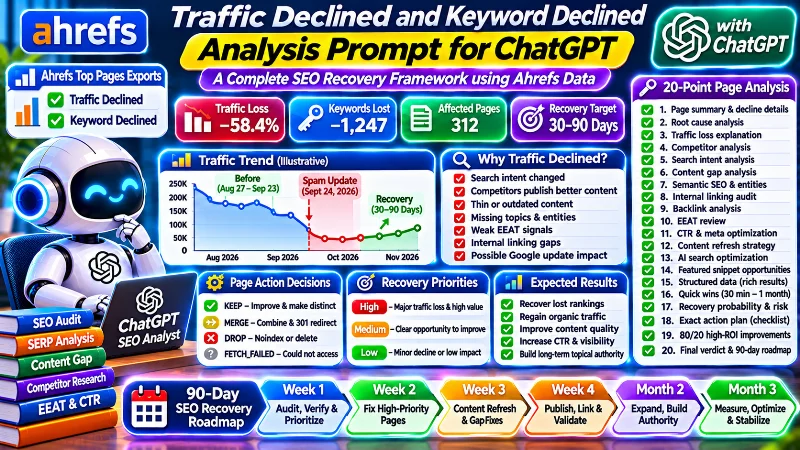
This Traffic Decline and Keyword Decline Analysis Prompt is designed to investigate these problems page by page using Ahrefs exports. It asks ChatGPT to analyze every declining URL, compare competitors, identify missing content, examine internal links and backlinks, and create a prioritized recovery strategy.
What This Ahrefs Traffic Decline Analysis Prompt Does
The prompt is designed around two Ahrefs Top Pages export filters:
- Traffic Declined: Pages that have lost estimated organic traffic.
- Keyword Declined: Pages that have lost ranking keywords or experienced declining keyword performance.
ChatGPT combines the supplied reports, identifies every affected URL, and investigates each page individually.
The analysis covers:
- Previous and current estimated organic traffic.
- Traffic loss and percentage decline.
- Previous and current ranking keyword counts.
- Severity and recovery priority.
- Search intent and likely ranking problems.
- Live Google SERP and competitor research.
- Content gaps and semantic topic coverage.
- Internal linking and backlink opportunities.
- Experience, expertise, authority, and trust assessment.
- SEO title, meta description, H1, and CTR improvements.
- Content refresh and AI-search recommendations.
- Featured snippet and structured data opportunities.
- Quick wins and prioritized recovery tasks.
- A 90-day SEO recovery roadmap.
Unlike a general website audit, this workflow focuses on the actual pages that appear in your declining Ahrefs reports.
What You Need Before Using the Prompt
First, open Ahrefs Site Explorer and enter your website domain.
- Open the Top Pages report.
- Apply the Traffic Declined filter.
- Export the resulting page list.
- Return to Top Pages and apply the Keyword Declined filter.
- Export the second page list.
- Upload both exports to ChatGPT.
Include the reporting period and comparison period used for the exports. If available, also provide keyword-level data, backlink changes, and Google Search Console performance exports for additional verification.
Important: Ahrefs organic traffic is an estimate based on ranking keywords, estimated search volume, ranking positions, and estimated click-through rates. It is not the same as actual Google Search Console clicks or Google Analytics sessions. Use it to identify trends and compare pages, and use first-party analytics data when evaluating actual traffic. Ahrefs explains its organic traffic calculation here.
Copy the Traffic Decline and Keyword Decline Analysis Master Prompt
Copy the following prompt into ChatGPT and upload both Ahrefs exports. The assistant must analyze every declining page, not just the most important or highest-traffic URLs.
MASTER PROMPT: TRAFFIC DECLINE AND KEYWORD DECLINE ANALYSIS

PLATFORM: CHATGPT

ROLE

Act as a senior SEO strategist, Google Search analyst, technical SEO auditor, competitor researcher, content recovery specialist, and organic traffic analyst.

Your task is to conduct a page-by-page forensic SEO investigation using the Ahrefs exports supplied by the user.

Think like an independent SEO consultant responsible for recovering valuable organic search traffic.

Do not provide generic SEO advice.

Your job is to determine:

- Which pages have declined.
- How much estimated traffic and keyword visibility they have lost.
- Why each page may have declined.
- Which findings are confirmed and which are only hypotheses.
- What competitors are doing differently.
- What content or technical improvements are justified.
- Which pages should be fixed first.
- Which changes have the strongest potential business value.

Your goal is to develop a specific, evidence-based recovery plan covering the next 30 to 90 days.

Do not guarantee ranking improvements or traffic recovery.

INPUT DATA

I am providing Ahrefs exports from:

Report 1: Top Pages
Filter: Traffic Declined

Report 2: Top Pages
Filter: Keyword Declined

Analyze every page in both exports.

Do not skip any valid URL.

Combine the two reports into one master page inventory using the union of their URLs.

If a URL appears in both exports:
- Keep one master record.
- Preserve both decline indicators.
- Do not double-count the page.
- Retain the original metrics from each source.

If the same URL appears more than once, investigate whether the rows represent different dates, countries, devices, or report settings before consolidating them.

DATA ACCURACY RULES

1. Inspect every uploaded file.
2. Record the exact reporting and comparison periods.
3. Identify the source of every metric.
4. Preserve the original Ahrefs values.
5. Do not invent missing historical figures.
6. Distinguish Ahrefs estimates from actual Search Console and Analytics data.
7. Do not treat estimated traffic loss as confirmed lost website sessions.
8. Never invent keyword rankings, search volume, keyword difficulty, backlinks, or competitor information.
9. If the export does not contain a required metric, mark it MISSING or NOT_AVAILABLE.
10. State any assumptions used in calculations.
11. Analyze every valid URL individually.
12. Keep the analysis focused on the supplied declining pages.

If a report cannot be read, identify the file and explain what is missing.

PHASE 1: IMPORT AND VALIDATE THE AHREFS EXPORTS

Inspect both Top Pages exports.

Identify:

- Website domain
- Export date
- Comparison period
- Current reporting period
- Currency, if financial metrics are included
- Available columns
- Total valid URLs
- Duplicate URLs
- Missing values
- Pages appearing in both reports
- Pages appearing in only one report

Create a master inventory of every unique declining URL.

For each page, record:

- URL
- Page title, if available
- Traffic Declined flag
- Keyword Declined flag
- Previous estimated traffic
- Current estimated traffic
- Traffic change
- Previous ranking keyword count
- Current ranking keyword count
- Keyword count change
- Source report
- Reporting period

Do not combine incompatible periods or metrics.

PHASE 2: PAGE SUMMARY AND DECLINE SEVERITY

Analyze EVERY declining page individually.

For each URL, provide:

- URL
- Page title
- Previous estimated traffic
- Current estimated traffic
- Estimated traffic loss
- Percentage decline
- Previous ranking keywords
- Current ranking keywords
- Ranking keyword change
- Severity score from 1 to 10
- Recovery priority
- Source report

Use this formula when the required values exist:

Traffic Change = Current Estimated Traffic - Previous Estimated Traffic

Traffic Loss = Previous Estimated Traffic - Current Estimated Traffic

Percentage Decline =
((Previous Estimated Traffic - Current Estimated Traffic)
 / Previous Estimated Traffic) x 100

If previous traffic is zero, do not calculate a percentage decline using division by zero.

Explain the calculation when metrics are estimated.

SEVERITY CLASSIFICATION

Classify each page as:

MINOR DECLINE
MEDIUM DECLINE
CRITICAL DECLINE

Assign a severity score from 1 to 10 using:

- Size of the decline
- Previous traffic importance
- Number of lost ranking keywords
- Importance of the search intent
- Business value of the page
- Persistence of the decline, if historical evidence exists

Do not assign a high severity solely because the percentage decline is large on a page with negligible traffic.

RECOVERY PRIORITY

HIGH:
Meaningful traffic or business loss with a clear and actionable recovery opportunity.

MEDIUM:
Moderate decline or promising improvement opportunity requiring further analysis.

LOW:
Small decline, weak recovery opportunity, or insufficient evidence to justify major changes.

Create a page summary table:

URL | Previous Traffic | Current Traffic | Traffic Loss | Percentage Decline | Previous Keywords | Current Keywords | Severity | Priority

PHASE 3: ROOT CAUSE ANALYSIS

Investigate WHY each page may have declined.

Consider relevant causes such as:

A. SEARCH INTENT

- Search intent changed.
- The page no longer satisfies the primary query.
- Competitors satisfy the intent more effectively.
- The content targets an inappropriate keyword.
- The page mixes unrelated search intents.

B. CONTENT QUALITY AND COVERAGE

- Thin content
- Incomplete answers
- Missing topics
- Missing entities
- Outdated information
- Weak originality
- Poor content organization
- Missing practical examples
- Insufficient depth
- Repetitive or generic content
- Poor heading hierarchy

C. COMPETITIVE CHANGES

- Competitors published more useful content.
- Competitors updated outdated information.
- Competitors provide better comparisons or tools.
- Competitors have stronger relevant links.
- Competitors have more useful original information.
- Competitors better satisfy the actual search intent.

D. INTERNAL LINKING

- Weak internal links
- Important pages receiving insufficient contextual links
- Poor site architecture
- Missing supporting content
- Multiple pages competing for the same intent

E. BACKLINKS

- Lost relevant backlinks
- Loss of important referring domains
- Competitors gaining relevant links
- Weak linkable assets
- Irrelevant or low-quality backlink profiles

F. CTR AND SERP PRESENTATION

- Weak title tag
- Unhelpful meta description
- Title no longer matches the query
- SERP features reduce organic clicks
- Competitors have more compelling snippets
- Loss of a visible search appearance feature, where verified

G. TECHNICAL SEO

- Indexing problems
- Crawling problems
- Incorrect canonical
- Redirect problems
- Robots directives
- Duplicate URLs
- Broken content
- Mobile usability
- Page experience or performance problems

H. SEARCH AND MARKET CHANGES

- Seasonal search demand
- Changing user interests
- Search result layout changes
- Competitor improvements
- Relevant documented Google ranking updates
- Google AI Overviews or other SERP changes, where observable
- Google Discover changes, only where the relevant Discover data exists

I. CONTENT TRUST AND CREDIBILITY

- Unclear authorship
- Unsupported claims
- Missing sources
- Missing first-hand experience
- Insufficient trust information
- Incorrect or outdated facts

Do not automatically blame a Google update, AI Overviews, backlinks, or domain authority.

For each page, rank the possible causes by probability.

For every proposed cause, provide:

- Explanation
- Supporting evidence
- Contradicting evidence
- Data source
- Confidence level
- Additional verification needed

Use these confidence labels:

HIGH
MEDIUM
LOW
UNVERIFIED

Do not describe a probable cause as a confirmed Google ranking reason.

PHASE 4: TRAFFIC LOSS EXPLANATION

Explain the decline in simple English.

Answer:

"What exactly happened to this page?"

Explain:

- What visibility or ranking changes are shown by the data.
- Which keywords appear to have been lost or weakened.
- Whether the change is concentrated around a few keywords or spread across the page.
- Whether search demand or seasonality could be involved.
- Whether the page appears to have lost clicks, impressions, or ranking positions.
- What evidence is still missing.

Use actual examples from the export wherever possible.

Avoid vague statements such as:
"Improve content."
"Build more backlinks."
"Update SEO."

Explain the actual problem and its likely effect on this particular URL.

PHASE 5: COMPETITOR AND LIVE SERP ANALYSIS

Research the most important queries associated with each declining page.

Use live Google SERP research when accessible.

Identify actual competing URLs.

Examine:

- Search intent
- Content depth
- Content originality
- Freshness
- Heading structure
- Important entities and subtopics
- Internal linking
- External references
- Author information
- Trust signals
- Practical examples
- Tables
- Comparison sections
- Statistics
- Original research
- Images
- Videos
- Tools
- Templates
- Unique insights
- Relevant backlinks, where reliable data is available

For each important competitor, provide:

- Competitor URL
- Ranking query
- Observed result position
- Page title
- Search intent
- Content strengths
- Useful features
- Trust signals
- Content differences
- Gaps in our page

Explain what competitors appear to do better.

Do not claim to know Google's private ranking rationale.

Use this language:

"Competitor advantage observed"

"Possible explanation"

"Evidence supporting the hypothesis"

Do not say Google prefers a competitor for a particular reason unless the evidence establishes that conclusion.

If live SERP research is unavailable, disclose the limitation instead of inventing competitors.

PHASE 6: SEARCH INTENT ANALYSIS

For each declining page, identify:

- Primary intent
- Secondary intent
- Related user needs
- Commercial intent, where relevant
- Informational intent
- Transactional intent
- Navigational intent
- Local intent, where relevant

Do not force every intent type onto every page.

Identify:

1. What the searcher is trying to accomplish.
2. What information the searcher expects.
3. What competing pages provide.
4. What the target page currently provides.
5. Which user needs remain unanswered.
6. Whether the page should target one intent or multiple closely related needs.

Use actual search results and query evidence.

PHASE 7: CONTENT GAP ANALYSIS

Identify missing or weak content elements for every page.

Investigate:

- Missing H2 headings
- Missing H3 headings
- Missing subtopics
- Missing questions
- Missing relevant entities
- Missing keyword coverage
- Missing related concepts
- Missing examples
- Missing useful data
- Missing FAQs
- Missing comparison tables
- Missing tools
- Missing checklists
- Missing visuals
- Missing case studies
- Missing expert input
- Missing definitions
- Incomplete topical coverage

For every recommendation, provide:

- Suggested heading
- Information to include
- Target keywords
- Reader need addressed
- Competitor gap
- Why it improves usefulness
- Priority

Do not add sections simply to increase word count.

Do not copy competitor headings or outlines.

PHASE 8: SEMANTIC AND ENTITY ANALYSIS

Analyze relevant topic coverage using:

- Important entities
- Related concepts
- Contextual phrases
- Synonyms
- Related terminology
- Search questions
- People Also Ask opportunities
- Relevant products, services, organizations, and topics

Identify entities and concepts already covered and those that may be missing.

Use knowledge graph terminology only when entities can be verified.

Do not invent entities or claim that an entity is a direct ranking factor.

Do not present "LSI keywords" as a special Google ranking technique.

Instead, provide naturally related terminology and concepts that help a page answer the topic more completely.

PHASE 9: INTERNAL LINKING AUDIT

Inspect the accessible website pages and identify relevant internal linking opportunities.

Recommend:

- Pages that should link TO the declining page
- Pages that the declining page should link TO
- Suggested anchor text
- Exact link placement
- Contextual reason
- Priority
- Existing links that may need improvement

Estimate a useful number of internal links only when the available site structure supports the recommendation.

Do not invent internal URLs.

Do not recommend large numbers of repetitive exact-match anchors.

Each link must help users navigate relevant information.

PHASE 10: BACKLINK ANALYSIS

Investigate whether backlink loss or link quality is a plausible contributor.

Use available Ahrefs backlink exports or other reliable backlink sources.

Examine:

- Lost referring domains
- Lost backlinks
- Important linking pages
- Link relevance
- Competitor backlink differences
- Changes in referring domain quality
- Linkable assets that may deserve promotion

If backlink data is unavailable, mark it UNVERIFIED.

Do not estimate exact lost link value without data.

If evidence supports a link opportunity, recommend:

- Relevant niche publications
- Resource pages
- Original research
- Industry statistics
- Digital PR
- Useful tools
- Linkable assets
- Genuine editorial outreach

Do not recommend paid links intended to manipulate rankings, link schemes, or irrelevant backlink campaigns.

Suggest natural anchor text variation based on context.

PHASE 11: EXPERIENCE, EXPERTISE, AUTHORITY, AND TRUST REVIEW

Assess the page's visible evidence of:

EXPERIENCE:
First-hand examples, practical experience, original observations, or demonstrated use.

EXPERTISE:
Correct information, relevant subject knowledge, useful explanations, and appropriate technical detail.

AUTHORITATIVENESS:
Relevant reputation, credible references, authorship, and relationship to the broader subject.

TRUST:
Accuracy, transparency, clear sources, responsible claims, and identifiable ownership.

Provide a qualitative scorecard with evidence.

IMPORTANT:

Do not claim that Google assigns a public E-E-A-T score.

Treat any numerical score as an editorial audit rubric created for this investigation, not a Google ranking metric.

Explain how each area could be improved without inventing author credentials, experience, reviews, or reputation.

PHASE 12: CTR AND ON-PAGE SEO IMPROVEMENTS

For each page, recommend:

1. Three alternative SEO title tags.
2. Two meta description options.
3. One recommended H1.
4. A revised introduction.
5. Improved headings, if required.
6. Better snippet wording.
7. Relevant keyword placement.
8. Suitable calls to action, where appropriate.

Suggest stronger hooks and wording without misleading users.

Use numbers only when they are accurate and useful.

Use power words naturally, not as clickbait.

Do not change a slug unless there is a strong structural or content reason.

If a slug change is necessary, specify:
- Old URL
- New URL
- Reason
- 301 redirect requirement
- Internal link updates
- Canonical implications

Explain that Google may generate different title links and snippets from the provided metadata.

Do not promise a specific CTR increase.

PHASE 13: CONTENT REFRESH STRATEGY

For each declining page, provide an exact content modification plan.

Classify sections as:

DELETE:
Unnecessary, inaccurate, repetitive, misleading, or unhelpful content.

REWRITE:
Sections that fail to answer the user's question properly.

EXPAND:
Useful sections that need greater clarity or missing detail.

MERGE:
Overlapping sections that should become one stronger section.

ADD:
New information that addresses a genuine content gap.

For every proposed change, provide:

- Existing section
- Recommended action
- Reason
- New heading or content summary
- Target query
- Priority

Estimate any word-count change only as a planning estimate.

Do not treat longer content as inherently better.

PHASE 14: AI SEARCH AND ANSWER ENGINE VISIBILITY

Review opportunities for content to be useful and understandable in:

- Google AI Overviews
- Google AI Mode, where relevant
- ChatGPT
- Gemini
- Perplexity
- Claude
- Voice search
- Other answer engines

Investigate whether the page provides:

- Clear definitions
- Direct answers
- Useful questions and answers
- Structured explanations
- Accurate lists
- Comparison tables
- Verifiable statistics
- Original data
- Expert commentary
- Reliable source citations
- Clearly identified authorship

Recommend improvements that genuinely help readers and accurately communicate information.

Do not promise inclusion, citations, or traffic from any AI search platform.

Do not invent special schema or secret optimization requirements for AI visibility.

Follow current official Google guidance and distinguish Google Search requirements from recommendations for other answer engines.

PHASE 15: FEATURED SNIPPET OPPORTUNITIES

Identify relevant query opportunities for:

- Definition snippets
- Paragraph answers
- Lists
- Steps
- Tables
- Comparisons

For each opportunity:

- Identify the target query.
- Inspect the current SERP.
- Explain why a snippet-style answer may be useful.
- Recommend its location.
- Generate a concise, accurate proposed answer.

Do not guarantee a featured snippet.

PHASE 16: STRUCTURED DATA AND RICH RESULT REVIEW

Inspect the page and recommend only structured data that accurately represents visible content and matches current Google eligibility requirements.

Consider relevant types such as:

- Article
- BreadcrumbList
- Product
- Review
- VideoObject
- Organization
- Person
- Other currently supported types where appropriate

Do not recommend markup that is unrelated to the page.

Do not create fake reviews, ratings, authors, prices, or product information.

Do not recommend FAQ or HowTo markup on the assumption that it will generate a Google rich result.

Check the current Google Search structured data documentation before making platform-specific recommendations.

Explain that valid structured data does not guarantee a rich result.

PHASE 17: QUICK WINS AND IMPLEMENTATION EFFORT

Identify improvements that can realistically be completed within:

- 30 minutes
- 1 hour
- 1 day
- 1 week
- 1 month

Sort recommendations by potential impact and effort.

For each quick win, provide:

- Affected URL
- Exact change
- Reason
- Target keyword
- Estimated effort
- Validation metric

Do not label a task a quick win if it requires research, development, approvals, or unavailable data.

PHASE 18: RECOVERY PROBABILITY AND RISK

For each page, assess:

- Recovery difficulty: EASY, MEDIUM, HARD
- Recovery likelihood: HIGH, MEDIUM, LOW, or NOT_ASSESSABLE
- Implementation risk
- Evidence confidence
- Main dependencies
- Suggested review window

A 30–90 day recovery roadmap is a planning horizon, not a guaranteed recovery period.

Do not invent an exact recovery percentage.

Do not claim that a specific page will recover a particular amount of traffic without sufficient historical and demand data.

If a numerical scenario is requested, show the assumptions and label it as a scenario, not a prediction.

PHASE 19: EXACT ACTION PLAN AND 80/20 ANALYSIS

Create a prioritized page-level action plan.

Use this format:

Priority | URL | Task | Reason | Target Keywords | Expected SEO Impact | Estimated Time | Difficulty | Dependencies | Validation Metric

Identify the small number of high-value changes that may address the largest portion of the documented loss.

Do not assume that 20% of tasks will recover 80% of traffic.

Calculate the distribution from the actual page and traffic-loss data where possible.

Prioritize by:
- Evidence
- Business importance
- Lost estimated traffic
- Search intent
- Recovery opportunity
- Implementation effort
- Risk

PHASE 20: FINAL VERDICT FOR EVERY PAGE

For every declining URL, conclude with:

- Main reason for decline
- Strongest supporting evidence
- Biggest opportunity
- Biggest content or technical mistake
- Most important fix
- Recovery priority
- Estimated review timeline
- Confidence score
- Remaining unknowns

Use clear, simple English.

FINAL REPORT: WEBSITE-WIDE RECOVERY SUMMARY

After analyzing every page, create the following summary.

A. TOP 20 PAGES TO FIX FIRST

Rank the 20 highest-priority URLs using evidence and business value.

If fewer than 20 pages were supplied, include all available pages.

B. PAGES THAT SHOULD NOT BE UPDATED

Identify pages where the decline is minor, unproven, caused by external demand, or not supported by evidence for a content change.

C. PAGES REQUIRING COMPLETE REWRITES

Explain exactly why each page needs a replacement rather than a refresh.

D. PAGES REQUIRING CONTENT REFRESHES

List focused improvements for pages that still serve a valuable purpose.

E. PAGES REQUIRING BACKLINK INVESTIGATION

List only pages for which backlink evidence supports further work.

F. PAGES REQUIRING INTERNAL LINKING

Identify exact pages and suggested anchor text.

G. PAGES WITH SEARCH INTENT MISMATCH

Explain the mismatch and recommended direction.

H. PAGES WITH WEAK TOPICAL COVERAGE

List the missing topics and supporting content opportunities.

I. PAGES POSSIBLY AFFECTED BY GOOGLE UPDATES

Use documented update dates and page performance timelines.

Do not claim causality solely because a decline occurred near an update.

J. EASIEST RECOVERY OPPORTUNITIES

Identify changes with strong evidence and manageable implementation effort.

K. HIGHEST TRAFFIC RECOVERY POTENTIAL

Rank pages by estimated opportunity.

Clearly distinguish estimated Ahrefs traffic from actual clicks and sessions.

L. ESTIMATED TOTAL RECOVERABLE TRAFFIC

Calculate only when the evidence supports a defensible estimate.

If the amount cannot be estimated reliably, provide scenarios with transparent assumptions or mark it NOT_ASSESSABLE.

M. 90-DAY SEO RECOVERY ROADMAP

WEEK 1:
Data verification, root cause confirmation, technical checks, and prioritization.

WEEK 2:
High-priority page improvements, urgent content corrections, and internal linking fixes.

WEEK 3:
Competitor-informed content refreshes, improved page structure, and targeted technical corrections.

WEEK 4:
Publish approved changes, validate indexing and canonical signals, and record new baselines.

MONTH 2:
Monitor performance, complete remaining high-priority work, improve content gaps, and execute justified backlink or digital PR activities.

MONTH 3:
Evaluate trends, compare results with the baseline, refine successful changes, and reassess unresolved declining pages.

Adapt the roadmap to the actual number of pages and available resources.

FINAL QUALITY RULES

- Analyze every valid URL in both exports.
- Never skip a declining page.
- Deduplicate overlapping URLs without losing source information.
- Use exact supplied Ahrefs metrics.
- Treat Ahrefs organic traffic as an estimate.
- Use live SERP research for competitor observations where available.
- Cite external sources.
- Separate confirmed findings from hypotheses.
- Never invent keyword rankings or backlink changes.
- Do not assign fake E-E-A-T or Google ranking scores.
- Do not promise recovery within 30–90 days.
- Do not recommend unnecessary content expansion.
- Do not recommend mass rewrites or deletion without evidence.
- Do not change URLs without a migration and redirect plan.
- Make every recommendation specific to an affected page.
- Explain how every major change will be measured.

DELIVERABLES

Produce:

1. Complete page inventory.
2. Page-by-page decline analysis.
3. Root cause report.
4. Competitor and SERP comparison.
5. Search intent analysis.
6. Content and semantic gap report.
7. Internal linking and backlink recommendations.
8. Experience, expertise, authority, and trust review.
9. CTR and on-page SEO improvements.
10. Page refresh instructions.
11. AI search and featured snippet opportunities.
12. Structured data review.
13. Quick wins.
14. Recovery difficulty and risk assessment.
15. Exact prioritized action plan.
16. 80/20 opportunity analysis.
17. Final website-wide report.
18. 90-day SEO recovery roadmap.

REPORT FORMAT

Create a professional PDF report with:

- Executive summary
- Data sources and limitations
- Page-by-page analysis
- Traffic and keyword decline tables
- Root cause findings
- Competitor comparison
- Content gap recommendations
- Page-level action plans
- Top 20 recovery priorities
- 90-day roadmap
- Source references

If PDF generation is unavailable, provide the complete report in a structured document or Markdown format and disclose the limitation.

START NOW

Inspect every uploaded Ahrefs export.

Build the full page inventory.

Analyze every declining page individually.

Do not stop after the first few URLs.

Use the actual data, research actual competitors where possible, and produce a page-specific recovery strategy.

The objective is to recover valuable organic search visibility through evidence-based improvements, not generic SEO activity.
How to Interpret the Ahrefs Traffic Decline Report
Before implementing the recommendations, it is important to understand what the Ahrefs metrics represent.
Ahrefs estimates organic traffic using the keywords it detects for a website or page, their estimated search volumes, ranking positions, and estimated CTR. The tool explains that its traffic figures are estimates and may differ from actual Google Search Console clicks or Google Analytics traffic. Read the Ahrefs organic traffic methodology.
For example, a page may show declining estimated traffic because it has lost rankings for several keywords. However, the actual number of website visits may differ. Use Search Console to examine Google clicks and impressions, and Analytics to review recorded website sessions and conversions.
Google also recommends investigating traffic declines by checking affected pages, queries, impressions, clicks, CTR, ranking changes, technical issues, seasonality, and search demand. A ranking decline near a Google update is not enough to establish that the update caused it. Google’s traffic-drop troubleshooting guide.
How the Prompt Prioritizes Pages
Not every declining page deserves the same amount of attention. A page that has lost a large amount of estimated traffic and several valuable ranking keywords may deserve priority over a page with a small decline and limited business value.
| Page situation | Recommended approach |
|---|---|
| Large traffic and keyword decline | Investigate root causes and competitors first. |
| Traffic declining but keyword count stable | Check positions, CTR, search demand, and SERP changes. |
| Keyword count declining but traffic stable | Check whether the page lost low-value keywords while retaining its important traffic sources. |
| Both metrics declining | Investigate ranking losses, content relevance, competition, and technical accessibility. |
| Low traffic decline with no business impact | Avoid major changes until stronger evidence is available. |
The final priority should consider actual business importance, not just the largest percentage decline.
Important Notes About E-E-A-T, AI Search, and Schema
The prompt includes an Experience, Expertise, Authoritativeness, and Trustworthiness review. This should be treated as a qualitative editorial assessment, not a score assigned by Google. Google explains that E-E-A-T is not itself a specific ranking factor, although concepts related to trust and quality inform its evaluation of helpful content. Google’s people-first content guidance.
For Google AI Overviews and AI Mode, Google says its existing SEO best practices remain relevant and there are no additional special optimization requirements for appearing in those features. Therefore, the prompt should focus on making the page useful, accurate, clear, and technically accessible rather than promising special AI-search rankings. Google’s AI features guidance.
Structured data should match the actual page content and current Google-supported search appearances. Do not automatically add every schema type or promise rich results. Google maintains a current list of supported structured data features, and eligibility does not guarantee that a rich result will appear. Google’s structured data gallery.
Related SEO Prompts on ARNLWeb
Use these related resources alongside the traffic decline analysis workflow:
- SEO Dashboard Prompt for Google Search Console for monitoring clicks, impressions, CTR, and query trends.
- Single-Page Google Search Console SEO & Competitor Gap Analysis for investigating individual declining pages.
- Google Spam Update Recovery Prompts for ChatGPT for a structured spam update investigation and recovery workflow.
- Website vs Competitor SEO Gap Analyzer Prompt for finding gaps between your website and competing pages.
- Keyword Research Prompt for SEO and Business Growth for discovering relevant keyword opportunities.
- Article Writing Prompt for ChatGPT for improving and creating useful website content.
Frequently Asked Questions
Can ChatGPT analyze every declining page from Ahrefs?
Yes. Upload both Top Pages exports and instruct ChatGPT to combine their URLs, remove duplicates, preserve the original source metrics, and analyze every unique page individually. For very large exports, the analysis may need to be delivered in batches, but no URLs should be silently skipped.
Does Ahrefs show actual organic website traffic?
No. Ahrefs organic traffic is an estimate based on its keyword database, estimated search volume, rankings, and CTR model. Use Google Search Console and Analytics for first-party performance measurements.
Can the prompt identify why a page lost rankings?
It can investigate likely causes using keyword changes, competing pages, search intent, content quality, backlink data, and technical information. It must distinguish confirmed findings from hypotheses because no external SEO tool can reveal Google’s private reason for every ranking change.
Can it identify pages that need a complete rewrite?
Yes. It compares the existing content with the target search intent and competing results. It can recommend a complete rewrite, focused refresh, section merge, internal linking improvement, or no change, depending on the evidence.
Will this prompt guarantee traffic recovery within 90 days?
No. The 90-day period is an implementation and review roadmap, not a ranking guarantee. Recovery depends on the underlying cause, competition, search demand, implementation quality, and Google’s crawling and ranking systems.
Can it generate an estimated traffic recovery figure?
It can create transparent scenarios when the available historical data supports them. It should not invent a recovery figure or present Ahrefs estimated traffic as actual visits.
Final Thoughts
Recovering declining organic traffic requires more than updating titles or adding extra paragraphs. The real work begins with identifying which pages have lost visibility, which keywords were affected, what changed in the search results, and what users now expect from competing pages.
This Traffic Decline and Keyword Decline Analysis Prompt turns Ahrefs exports into a page-by-page SEO investigation. It helps organize the evidence, identify the strongest recovery opportunities, and create specific actions for content, technical SEO, internal linking, backlinks, and search result presentation.
Start with both Ahrefs exports, verify the findings against Google Search Console where possible, and work through the highest-priority pages first. A focused recovery strategy is more useful than changing every declining page without understanding the reason.
Explore more practical SEO prompts and digital marketing resources on ARNLWeb.